

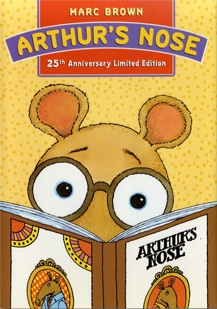
Today for Great Books Week (October 6-12) , I’d like to look at a modest picture book that launched an empire: Marc Brown’s Arthur’s Nose. In 1976 a failed television weatherman, Marc Brown, published his first picture book under the astute guidance of Emilie McLeod of Atlantic Monthly Press. Emilie, one of those most respected editors working in Boston publishing, had exquisite taste and an eye for new talent. She published Sid Fleischman and Eleanor Cameron, fought for The Incredible Journey and took a chance on Marc’s first attempt to both write and illustrate a book.
When Marc’s son Tolan requested a bedtime story about a weird animal, Marc started to go through the alphabet, and for the letter A he came up with Aardvark. As he developed the plot, though, he discovered that his hero was simply a young child who looked like an Aardvark. In other words, Arthur is an aardvark, but he faces the same dilemmas of every young child in school. To write the books, Marc recorded what he observed with his own children, Tucker, Tolan, and Eliza. Over the years the book grew in popularity; eventually PBS picked up this popular series and made Arthur recognizable worldwide.
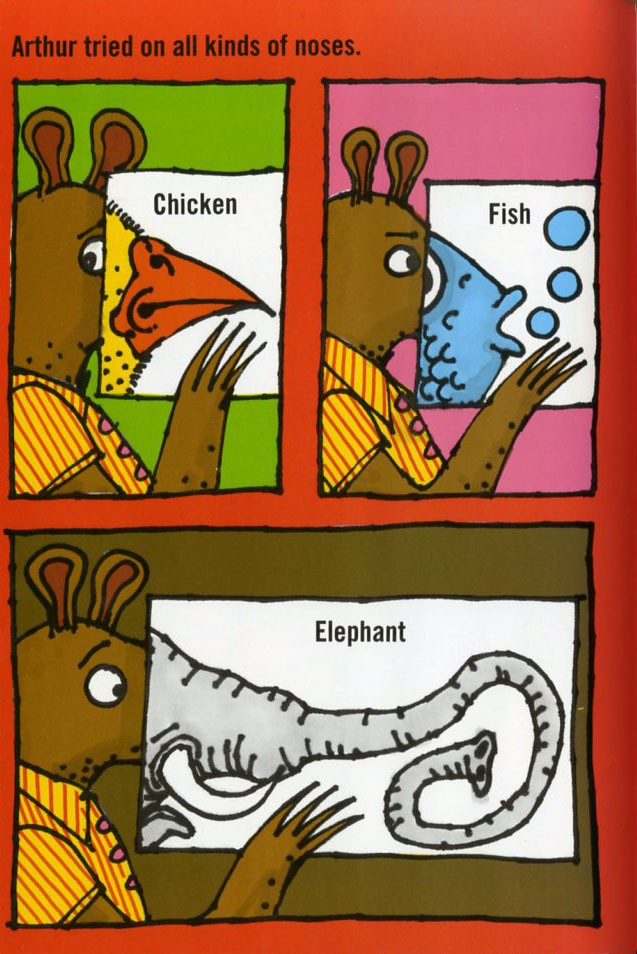
Those who only know the PBS series or later Arthur books might be quite surprised when they pick up the original volume. Arthur worries about his nose—he has an anteater-sized schnoz. When he plays hide and seek, his nose always gives him away. So Arthur goes to a rhinologist, but after trying out various possibilities, he decides to stay with the nose nature has given him. In the 25th anniversary of the book, Marc Brown shows Arthur’s nose as it has evolved over the years. The creator definitely opted for rhinoplasty as the series evolved. Arthur gains glasses—but loses his aardvark nose.
The series has worked so well over the years not because of a nose but that Arthur has become friends with children everywhere. In him they see reflections of themselves; he has an entire cast of friends, many who also become the stars of their own books, and he’s funny and approachable and gentle. Much like Marc Brown himself. It has been such a pleasure to watch one of the nicest people in the children’s book world also become one of the most successful.
Arthur’s Nose ends with the words, “There is a lot more to Arthur than his nose.” And indeed with more than fifty million copies of the Arthur books in print, Arthur has demonstrated his attraction to children for thirty-five years! In that time Arthur has moved from the star of a modest picture book to becoming a household name.
Here’s a page from Arthur’s Nose: