


On March 2, 1904, Theodor Seuss Geisel was born in Springfield, Massachusetts. Seuss won a Pulitzer Prize for lifetime contribution, one of the few children’s book creators ever so honored, and his books have sold over 200 million copies.
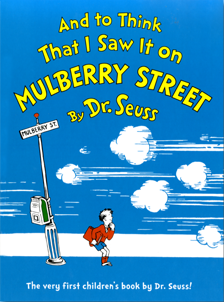
Like so many of our pivotal children’s book creators, Seuss struggled to get his first book published. He had submitted And to Think I Saw It on Mulberry Street to twenty-four to twenty-seven publishers—the number varied as he told the story over the years. During the 1930s, when picture books tended to carry serious messages, Dr. Seuss’s lighthearted nonsense went against the tide. According to the story Seuss told, he was walking down Madison Avenue, his last rejection in hand, on the way to his apartment to burn this manuscript. Then the fates intervened. Seuss ran into a Dartmouth classmate on the street and began telling his tale of woe. But the more Seuss talked, the broader the smile on his friend’s face became. Asking why the smile, Seuss learned that his friend had just been hired at Vanguard Press, a small publisher. As a new children’s book editor he needed something to publish. Besides that, his friend knew nothing about children’s books—hence he could simply enjoy Seuss’s lighthearted nonsense. Conventional wisdom in publishing, then and now, can often blind editors to something fresh and original. Seuss always said that if he had been walking down the other side of the street that day, he would have gone into the dry cleaning business!
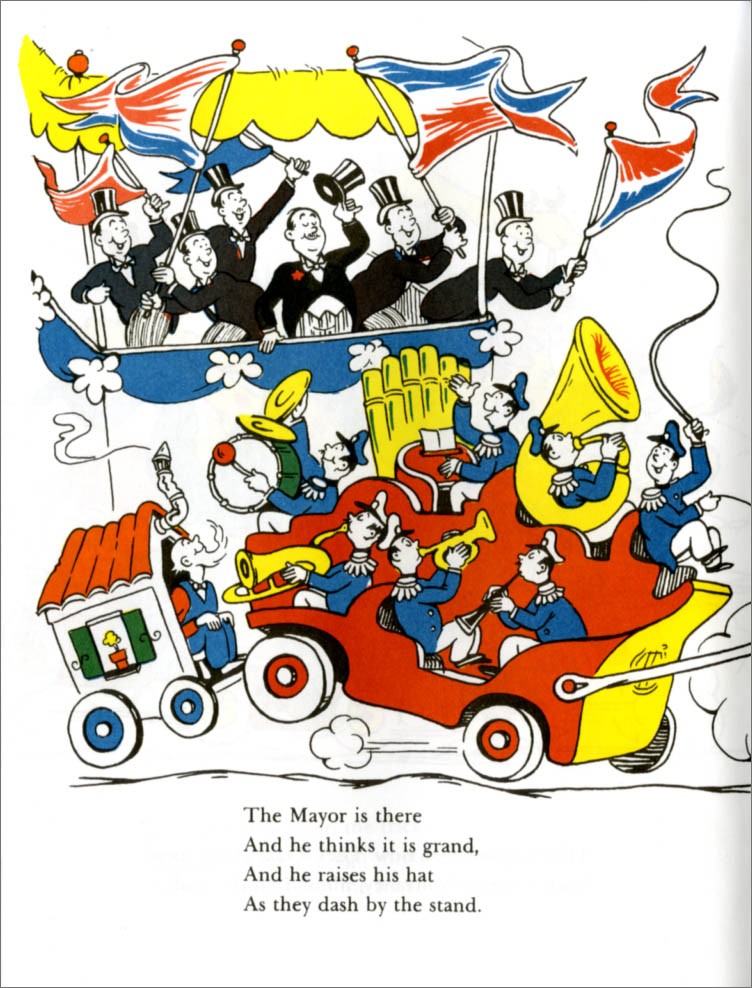
Only the title of the book was changed (originally called A Story That No One Can Beat). In spirited rhyme Seuss tells the story of Marco, who sees a broken-down wagon, drawn by a horse, on Mulberry Street and imagines all kinds of wonderful creatures appearing in the town. When Seuss offered up this madcap nonsense to children, they fell in love with him.
Like so many of our child-friendly authors, Seuss received few adult-selected awards—but his sales and the devotion of readers more than compensated. In later years, he would write Cat in the Hat, launch the Beginner Books series for Random House, and become a household name. In Bennett Cerf of Random House, he found a dedicated editor who once said, “I’ve published any number of great writers, from William Faulkner to John O’Hara, but there’s only one genius on my author list. His name is Ted Geisel.”
If you want more information, here’s a link to a video clip at About.com. I personally always spend March 2 being grateful that Dr. Seuss didn’t end up in the dry cleaning business.
Here’s a page from And to Think That I Saw It on Mulberry Street: