
On August 3, 1793, a young French sailor in Philadelphia, Pennsylvania, contracted a virulent fever, which worsened before he died. Newspaper accounts in the new nation’s capital did not even give his name, and everyone went about their usual business in the City of Brotherly Love. But from that moment on, an invisible killer stalked the streets of the city. The local doctors, who include Dr. Benjamin Rush, could not agree about the cause of the deaths. No one knew how to treat the patients. When scores began to die, they started to remove the barely living to a makeshift hospital away from the city. Everyone with means and money fled. The death count mounted daily. Because the city lacked sufficient medical personnel, the Free African Society, composed of former black slaves, became nurses for the patients. Then their members also began to sicken and die. When George Washington finally left the capital a couple of months later, he placed Secretary of War Henry Knox in charge of the country!
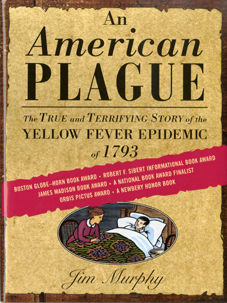
In An American Plague: The True and Terrifying Story of the Yellow Fever Epidemic of 1793 Jim Murphy, who can write like an angel even when describing a world of destruction and chaos, brings an absolutely gripping account of these events to young readers ages ten through fourteen. How does a plague get started? How effective is government in responding? How much do doctors really know about diseases they have rarely seen? If these sound like modern questions, think again: They all apply to the Epidemic of 1793.
An American Plague allows the reader to be swept up in events, breathlessly turning the pages. I myself first read it, unfortunately, on a hot summer night. Mosquitoes (the cause of the plague) flew in droves over the Vermont countryside outside my window. Because I couldn’t stop reading, by the morning I was convinced I had contacted a rare case of yellow fever. That is what great books do for you—they take you away to another place, another period in time, another reality.
Jim Murphy has been given the Margaret A. Edwards award for his exciting information books—including Blizzard, A Boy’s War, The Long Road to Gettysburg, and The Great Chicago Fire. If you don’t know his titles, An American Plague makes an excellent first choice. It makes an excellent book to pair with Laurie Halse Anderson’s Fever 1793. Just stay away from mosquitoes while you read it!
Here’s a section from An American Plague: