Daily children’s book recommendations and events from Anita Silvey.
Discover the stories behind the children’s book classics . . .
The new books on their way to becoming classics . . .
And events from the world of children’s books—and the world at large.

Find a Book!
Search the archives for recommendations by age group, book type, subject, date, and more.

A Wizard of Earthsea
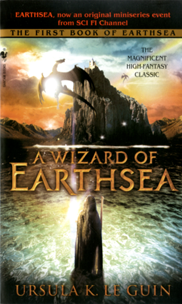
March has been set aside to recognize the contribution of small presses to our literary heritage. After I had finished selecting books for 100 Best Books for Children, I went back to calculate the percentage that had originally been published by small or independent publishing houses. 10 percent! An amazing figure when you realize that most books published appear on the lists of large houses, often owned by media corporations. Small presses, both in the U.S. and internationally, have always taken risks on new authors or unusual books. Dr. Seuss first appeared on such a list, as did J. K. Rowling in England. And so did Ursula K. Le Guin with her classic A Wizard of Earthsea.
Le Guin was best known, probably as she still is today, as a writer of adult science fiction and fantasy novels like The Left Hand of Darkness. In 1967 the publisher of the small California publishing house Parnassus Press, Herbert Schein, wrote to Le Guin, asking her to consider writing a book for children/young adults. Schein had published Ishi: Last of His Tribe by anthropologist Theodora Kroeber, Le Guin’s mother. Although Le Guin had not considered writing for this audience, she crafted a coming-of-age story, A Wizard of Earthsea, set in a fantasy world.
Taking place on an island community, presented in detailed maps, A Wizard of Earthsea shows the struggles of a young goatherd named Sparrowhawk (but called Ged) as he trains to become a wizard. Magic and wizardry are completely embraced by this community, and after some trials Ged earns his place in a school for wizards. Created long before Hogwarts, Le Guin’s wizard school tests and tries its members in very exacting ways. Although Ged initially does very well in his classes, his jealousy of another student causes him to engage in magic beyond his reach. Hence a dark shadow emerges, who haunts Ged to the far reaches of the kingdom. In the end, Ged must summon all his courage to face this shadow, name it, and merge with it.
Unlike much fantasy for children that is grounded in the Judeo-Christian tradition, A Wizard of Earthsea was inspired by the writings of Carl Jung. The heroes are brown or black skinned, not white. Although there are fabulous battles with dragons and evil sorcerers, much of Ged’s struggle comes from mastering the evil inside him—not the forces outside of him.
I knew none of this forty years ago when I picked up A Wizard of Earthsea, the first children’s fantasy I ever read. The only recognition the book initially received was The Boston Globe–Horn Book Award. Paul Heins, editor of Horn Book, thought it one of the great books of his time, so he put it into my hands. I was a realistic fiction and nonfiction reader; A Wizard of Earthsea was a type of book I had not encountered. For Paul, I read the first two chapters. Then, the writing swept me into the world of Earthsea. When I reread the book for this essay, I was amazed by how much detail has stayed with me over these years. It’s a mesmerizing book, an important book, a book that does not merely re-create Tolkien but adds something new to the fantasy cannon. All this and more can be said about A Wizard of Earthsea.
In this age when speculative fiction—fantasy, science fiction, and horror—is often the preferred choice of ten- to fourteen-year-olds, make sure they get a chance to travel to Earthsea. It can be read first in adulthood, but it is so much better if found as a young reader.
Here’s a passage from A Wizard of Earthsea:
At that Ged lifted up the staff high, and the radiance of it brightened intolerably, burning with so white and great a light that it compelled and harrowed even that ancient darkness. In that light all form of man sloughed off the thing that came towards Ged. It drew together and shrank and blackened, crawling on four short taloned legs upon the sand. But still it came forward, lifting up to him a blind unformed snout without lips or ears or eyes. As they come right together it became utterly black in the white mage-radiance that burned about it, and it heaved itself upright. In silence, man and shadow met face to face, and stopped.
Also recommended:
- The rest of the Earthsea saga and all the books of Ursula K. Le Guin
Additional Information
A few other events for
- Happy birthday Helen Caswell (Saint Francis Celebrates Christmas).
- It’s the birth date of Eric P. Kelly (1884–1960) The Trumpeter of Krakow, Joseph Gaer (1897–1969), Fables of India, Sid Fleischman (1920–2010), The Whipping Boy, and William Mayne (1928–2010), Hob and the Goblins.
- In 1995, Mississippi formally ratifies the 13th Amendment. It was the last state to approve of the abolition of slavery, though slavery was federally abolished in 1865. Read Mississippi Bridge by Mildred D. Taylor, illustrated by Max Ginsburg.
- It’s National Freedom of Information Day. Celebrate the First Amendment to the U.S. Constitution. Read First Freedoms: a Documentary History of First Amendment Rights in America by Charles C. Haynes, Sam Chaltain, and Susan M. Glisson.