
When Charles Dickens set out to write A Christmas Carol in 1843, both his fortune and his reputation had hit an all-time low. “Boz [Dickens’s pen name] is going down,” the gossips declared, and Dickens financial problems were known all over London. During this time the celebration of Christmas traditions in England were, as the poet Thomas Hood stated, “in danger of decay.” But Dickens short novella, written at fever pitch over a six-week period, would revive Dickens’s reputation as the most popular novelist in England. Also with this small novel he revitalized the Christmas holiday—just with the power of his pen.
Dickens drew on his own childhood and the life around him to fashion his story. Even the death of the child Tiny Tim was all too familiar to Dickens—he had lost a brother and a sister when a mere child himself. The boy Scrooge, left alone in the school during the holidays, finds children’s books to be his only friend, just as Charles Dickens did. And Dickens had been campaigning in 1843 on behalf of the children of the poor, an appeal that had found him an audience of believers. So drawing on experience and invention, Dickens locked himself in his house, excused himself from appointments, refused to see friends who dropped by, and worked all hours of the day and late into night. “No city clerk was ever more methodical or orderly than he,” Dickens’s eldest son Charley stated about his father.
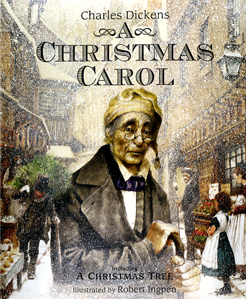
As is often the case with groundbreaking books, Dickens met some opposition to his creation. Although Dickens told a touching tale of the miser Ebenezer Scrooge who was taught the meaning of Christmas by a series of ghostly visitors, his publisher didn’t think the offering had much value. Ever the inventor, Dickens suggested the terms of his own arrangement. He would pay for the production of the book and be entitled to all profits; his publisher would get a small commission on each sale. (This is, by the way, a complete reversion of usual publishing arrangements.) Since Dickens controlled the book’s production, he made some important decisions about this “Ghost Story of Christmas.” The price would be kept low, only five shillings; he made the small book as handsome as possible, with a russet cloth binding and a stamp of gold on the front and spine. Published on December 19, 1843, A Christmas Carol became an immediate sensation, going through several printings right away. Even the Scottish philosopher Thomas Carlyle, known to be dour, “on reading the book, sent out for a turkey, and asked two friends to dine.” Thousands of editions have been issued over the years. Australian illustrator Robert Ingpen, winner of the Hans Christian Anderson Award, created an expressive and spirited rendition of the book in 2008. Today, of course, A Christmas Carol can be enjoyed in plays and movies, even now in a graphic novel.
Happy birthday to A Christmas Carol. This book reminds us that, as Scrooge’s nephew Fred says, Christmas can be “a good time: a kind, forgiving, charitable, pleasant time: the only time I know of in the long calendar year, when men and women seem by one consent to open their shut-up hearts.”
Here’s a page from A Christmas Carol:
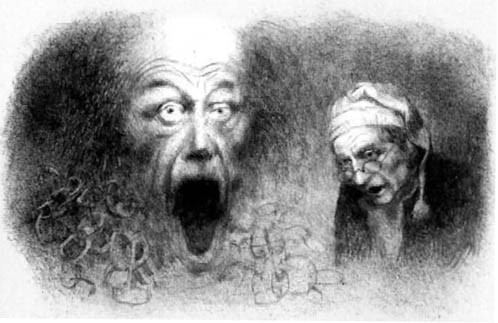
Marley was dead: to begin with. There is no doubt whatever about that. The register of burial was signed by the clergyman, the clerk, the undertaker, and the chief mourner. Scrooge signed it. And Scrooge’s name was good upon ‘Change, for anything he chose to put his hand to. Old Marley was as dead as a door-nail.
Mind! I don’t mean to say that I know, of my own knowledge, what there is particularly dead about a door-nail. I might have been inclined, myself, to regard a coffin-nail as the deadest piece of ironmongery in the trade. But the wisdom of our ancestors is in the simile; and my unhallowed hands shall not disturb it, or the Country’s done for. You will therefore permit me to repeat, emphatically, that Marley was as dead as a door-nail.