Daily children’s book recommendations and events from Anita Silvey.
Discover the stories behind the children’s book classics . . .
The new books on their way to becoming classics . . .
And events from the world of children’s books—and the world at large.
Find a Book!
Search the archives for recommendations by age group, book type, subject, date, and more.
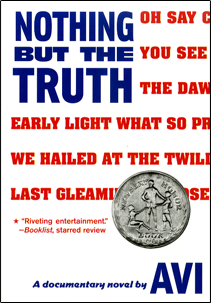
On December 18, 1956, one of the most popular long-running television shows, To Tell the Truth, premiered. Truth, of course, is a slippery thing. What seems true to one person does not appear that way to another. One of our best novels for ten- to fourteen-year-olds, published in 1991 and already a classic, explores the issues of what is true, what is false, and what is misleading. In Avi’s Nothing But the Truth, ninth grader Phillip Malloy faces problems both at school and at home. His only release comes in running and in his dreams of making the track team. But a D in English, from veteran teacher Margaret Narwin, ends his quest—although the track coach suggests that Phillip simply go to the teacher and see if he can make up work.
Phillip takes another approach—goading her. In her home room, when “The Star-Spangled Banner” is played “for respectful silent attention” over the public announcement system, Phillip starts to hum. After this continues and he refuses to stop, Ms. Narwin sends him to the vice principal, who eventually suspends him for repeated incidents of disrespect. Then Phillip and his father talk to the press—about the unpatriotic nature of the school. At this point, the media coverage all over the country causes the situation to spiral out of control.
The story itself is so suspensefully crafted that it would be a page-turner even if told as a straight narrative. But Avi has presented the differing points of view by using a variety of forms—memos, letters, conversations, interviews, and Phillip’s diary. Hence readers get to see the evolving story from multiple perspectives.
Well written, well paced, and provocative, Nothing But the Truth works brilliantly when read by a group—because everyone will come to a slightly different understanding of the events, depending on how he or she reads the evidence. How truthful would their testimonies seem to be if Phillip or Margaret Narwin were tried in a court of law? The book also examines how accurately our media relates real incidents.
Avi’s Nothing But the Truth is an engaging story, but it also causes readers to think about truth, lies, and the consequences.
Here’s a passage from Nothing but the Truth:
MR. GRIFFEN: Before I get into my formal speech, I’d like to lead off—put it right at the top of your thoughts—with something that has happened here in Harrison, something that has disturbed me greatly. I am a great believer in basic American values. And let me tell you good people—and I am sure I speak for you too—I am shocked that a Harrison student should be expelled from one of our schools because he desires to sing the national anthem. Yes, my friends, it is the truth. It has happened here.
Also recommended:
- Other compelling books by Avi
- Crispin
- The True Confessions of Charlotte Doyle
Additional Information
A few other events for
- Happy birthday Marilyn Sachs (The Bear’s House, A Pocket Full of Seeds).
- It’s the birth date of Alison Uttley (1884–1976) A Country Child, A Traveler in Time.
- Also born on this day was the Soviet Union leader Joseph Stalin (1878–1953). Read The Inner Circle: An Inside View of Soviet Life Under Stalin, by Andrei Konshalovsky and Alexander Lipkov.
- It’s New Jersey Day, in honor of this state’s birthday. In 1787, New Jersey was the third state to ratify the U.S. Constitution. Read Voices from Colonial America: New Jersey 1609–1776 by Robin Doak and The Wizard, The Witch, and Two Girls from Jersey by Lisa Papademetriou.
- Regardless of which winter holiday you celebrate, if any at all, enjoy Bake Cookies Day.