On December 9, 1793, Noah Webster established his newspaper, American Minerva. In 1828 Webster published An American Dictionary of the English Language and became the father of the American dictionary. People often wonder how words get into this standard reference tool. For years I worked down the hall from the talented staff that produced The American Heritage Dictionary; I watched them do media searches, build data bases, and quiz their usage panel—to get the next set of words to enter AHD. However, the hero of our book of the day has another idea about how to get a new word into the dictionary.
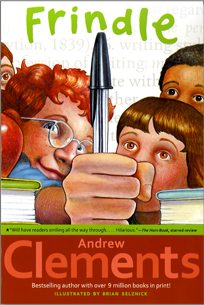
Meet Nick Allen—smart, funny, incredibly inventive. He always thinks outside the box and usually doesn’t even know there is a box. Now in fifth grade, he finds himself in the language arts classroom of Mrs. Granger, a woman who loves words and the dictionary. While reporting on the development of this reference tool, Nick comes up with one of his fabulous ideas. He will invent a word, get everyone he knows to use it, and create a new dictionary entry. In Frindle, Nick takes a writing pen, renames it “frindle,” and then watches as events spin out of control.
For one thing, he meets stern resistance in Mrs. Granger, who has some strong ideas about the appropriate use of language. But the students in school take up the cause of saying and writing frindle, as an exercise in civil disobedience. Then the media gets involved. But as Shakespeare said, “All’s well that ends well,” and Frindle has a totally satisfying, even tear-producing, ending.
Often on summer reading lists since it was published in 1996, Frindle can be used for a variety of classroom exercises. Author Andrew Clements knows how to keep the story action going so that readers want to turn the pages. Some teachers combine reading the book with asking the class to develop its own dictionary. Everyone gets a letter of the alphabet and researches old words—and like Nick they can add a new one of their own making. As a read-aloud or read-alone, the book has broad appeal for third through fifth graders.
A teacher at heart, Andrew Clements knows how to write funny, contemporary fiction, true to children’s behavior, that allows kids to think about greater issues as they enjoy the process of reading. Andrew is actually my hero of the day—even before Noah Webster and Nick Allen.
Here’s a passage from Frindle:
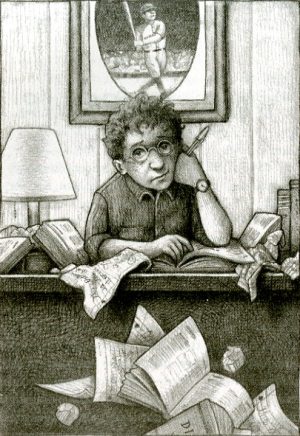 He leaned back on the couch and covered his eyes with his arm, trying to imagine himself giving a report on all this boring stuff. He’d be lucky to have three minutes worth. But because Nick was Nick, he suddenly had an idea and it brought a grin to his face.
Nick decided that giving this report could actually be fun. He could make it into something special. After all, Mrs. Granger had asked for it.