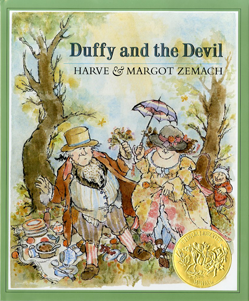
We’ll end the month of November with another birthday celebration, this time of one of the finest book illustrators of the twentieth century, Margot Zemach, born in 1931. Strangely, and I have never figured out why, male illustrators for children outnumber and generally outrank, in terms of accolades, their female counterparts. But Margot Zemach could hold her own with the men of the field, winning the Caldecott Medal for Duffy and the Devil.
Zemach came to her career in children’s books after studying at the Los Angeles County Art Institute and the Academy of Fine arts in Vienna, Austria, on a Fulbright Scholarship. Collaborating with her husband, Harve, on her first book, A Small Boy Is Listening, she depended on his writing talents for many of her publications. Often he provided delicious language for stories; she gave them life in her animated artwork. Not only could she draw like an angel—all of the work is based on strong composition and line—but she had an impeccable sense of design. To look at her work feels like going on a walk in a well-laid-out rose garden. She knew how to combine art, text, and type to make reading a pleasure. And white space—where the white paper is allowed to show through. She had no fear of white space!
The Zemachs often used folktales for the basis of their books. One of their best, It Could Always Be Worse, a Caldecott Honor, stems from a Yiddish folktale. Her Caldecott winner, Duffy and the Devil, was based on a Cornish folktale similar to Rumpelstiltskin. But nothing in her artwork seems borrowed or copied. Every book had freshness to the approach and liveliness in the illustration. I have always thought of Margot Zemach as a modern-day Randolph Caldecott, the great 19th century English illustrator. Her characters dance and move across the page—and she always manages to bring out the humor of the text and situation.
Children’s literature allows readers to bring all of their experiences to a book each time they pick it up. I was a young Horn Book reviewer when I first encountered Zemach’s work and fell in love with Duffy and the Devil. To humor me, Paul Heins, editor of The Horn Book and a great Zemach fan, of both Harve and Margot, allowed me the privilege of reviewing it for the magazine—because I was so passionate about the book. When this beautiful and spirited book won the Caldecott Medal, I felt as if I had won that medal myself! Every time I pick up the book, I read not only this story, but part of my story as well. That is what great children’s books do.
In 1989 Margot Zemach died of Lou Gehrig’s disease. But as with all our great creators, her books remain. So today I hope you pick some of them up and join me in celebrating what would have been her 80th birthday.
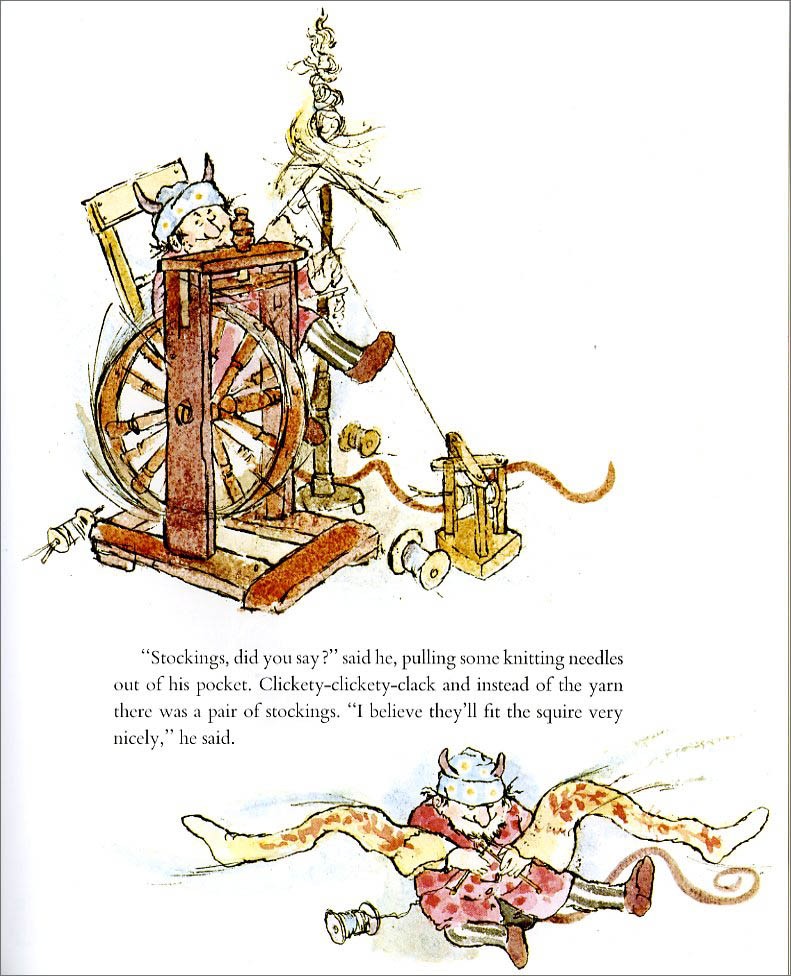
Here’s a page from Duffy and the Devil: