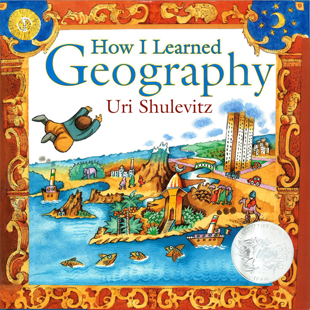
November has been designated Life Writing Month, dedicated to the idea that each person has a story to tell from his or her own history. Next week, we celebrate National Geography Week. Our book of the day, Uri Shulevitz’s How I Learned Geography, can be used for both occasions.
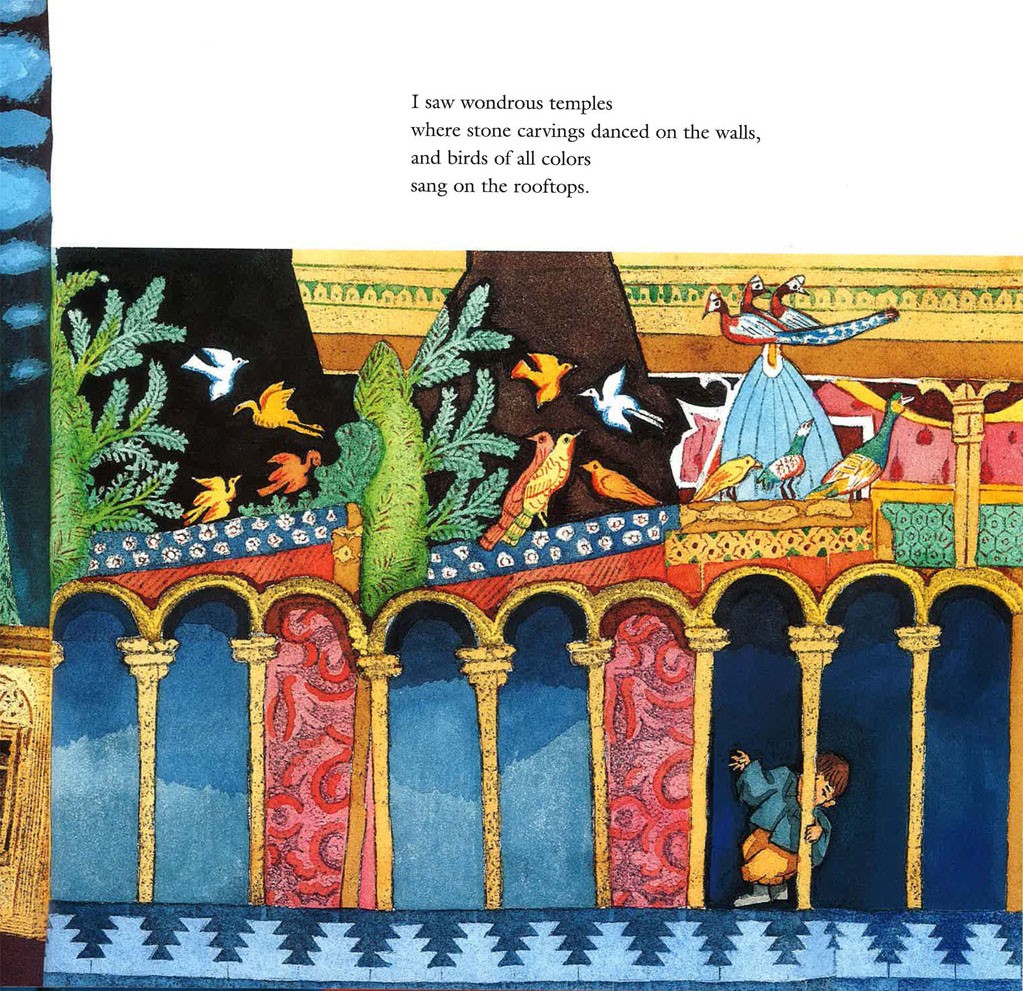
This powerful picture book, perennially popular with young readers, begins during World War II. “Everything we had was lost. We fled empty-handed,” the young protagonist states. When the family resettles in a strange new land, the father leaves to buy bread, but instead comes back with a map. That map becomes the wall decoration of their hovel, something for the boy to study and dream about. He draws sections on scraps of paper; he learns exciting words: Pennsylvania Transylvania Minsk. He imagines the deserts, the beaches, the mountains, the temples. Eventually, the boy moves to a city of tall buildings with endless windows, away from hunger and poverty, and realizes his father had been right to buy a map to enchant him rather than a small slice of bread.
In the endnote, Uri Shulevitz provides a brief overview of his life, completely appropriate for the readers ages four through nine. He talks about leaving Warsaw, Poland, during World War II to live in Turkestan, Paris, and finally New York. Published in 2008 and winner of a Caldecott Honor, the book presents an unforgettable life story of a young boy—and also attests to the power of learning and gaining an understanding of the world. Like all of Shulevitz’s work, the book’s division between text and art is absolutely brilliant; anyone wanting to comprehend the classic American picture book could do no better than conduct an author study of Uri Shulevitz.
When I picked up How I Learned Geography again, I had just finished reading Russell Shorto’s The Island at the Center of the World about the first Dutch settlers’ largely unsung contributions to New York. The Dutch encouraged a multicultural population and welcomed diversity. One of the largely untold stories in children’s books is how encouraging our community has been to authors and artists from other countries. The list of émigrés to whom we have opened our hearts and our children’s minds goes on and on—H.A. Rey, Ludwig Bemelmans, Tomi Ungerer, Peter Sís, Francisco Jiménez, and our hero of today, Uri Shulevitz. There has always been a place on publishing lists for well-told life stories that began in other countries. How I Learned Georgraphy is a shining example of such a book.
So I hope this book and Life Writing Month encourages others to tell their life stories in a universal way that can be appreciated by American children. And I hope that adults remember to share these stories with the young, broadening their sense of the world.
Here’s a page from How I Learned Geography: