
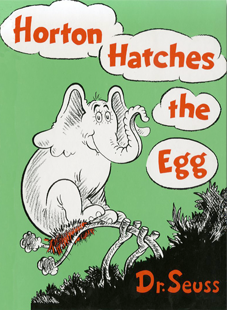
In October 1940 a new children’s book author and illustrator published his fourth book, one destined to become a classic. Admittedly since he had been rejected some twenty times for his first book, and then only been picked up by a small press, Vanguard, he did not necessarily seem to be poised to become America’s best-known and bestselling children’s book creator. But our book of the day definitely improved the trajectory of his career.
The beauty of children’s books, of course, is that we come to them at many moments in our lives—first in our own childhoods and then when we share them with children. When I touch the green and red cover of this seventy-one-year veteran, I am instantly transported back years. This book was a surefire staple when I babysat as a teenager. It never ceased to please whatever little rascals I had charge of for the evening. And although I have forgotten what I did yesterday, I can remember its refrain: “I meant what I said/And I said what I meant.…/An elephant’s faithful/One hundred per cent!”
Dr. Seuss’s Horton Hatches the Egg takes a sly look at the nature versus nurture debate. Seuss presents a less than ideal parent in the lazy Mayzie bird. She abandons her nest after she coaxes slow but steady Horton the Elephant to take care of her egg. And egg sit he does—through both threats to his life, which include snow, sleet, and lightning, and capture in a cage. With an ending that still makes me cheer, Horton does get his reward—an offspring who adores him!
So many different interpretations exist for Horton Hatches the Egg. In Everything I Need to Know I Learned from a Children’s Book, Karen Hesse writes, “I met my first genuine humanitarian in the elephant Horton.… I wanted to be like Horton. I wanted the world to be populated by Hortons. I wanted all the children of the world to be treated with the same loving devotion with which Horton treated the egg.”
For my own part, although it took me years to understand, I latched on to a very important premise: Even if your mother might not love you or want to stay with you, you can find someone who will. Someone important. Someone as fabulous as Horton.
Persistence, honor, devotion, all these traits form the character of our hero. May Horton live another seven decades. Since the publication of this book, the name Dr. Seuss has become synonymous with laughter; Horton Hatches the Egg shows us why.
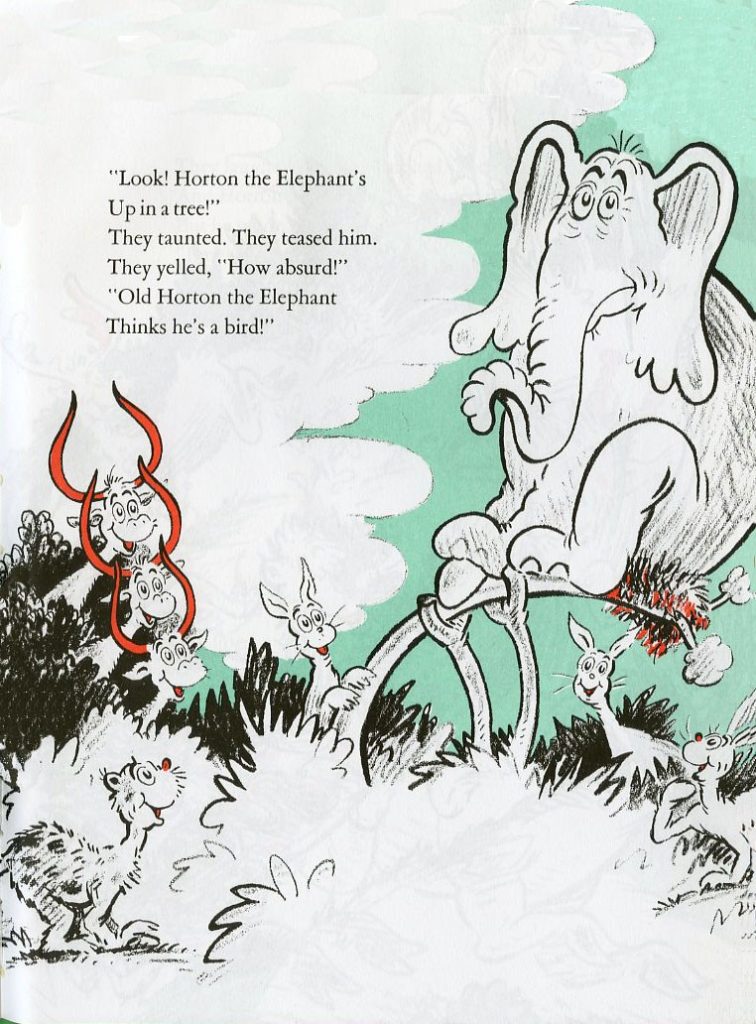
Here’s a page from Horton Hatches the Egg: