Daily children’s book recommendations and events from Anita Silvey.
Discover the stories behind the children’s book classics . . .
The new books on their way to becoming classics . . .
And events from the world of children’s books—and the world at large.
Find a Book!
Search the archives for recommendations by age group, book type, subject, date, and more.


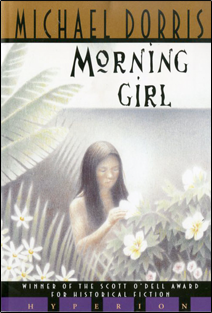
Today we celebrate Columbus Day. Every now and then a book not only educates you but changes the way you view history. Once you have read it, you cannot see things quite the way you once did.
That is how I think about the book of the day, Michael Dorris’s Morning Girl. Published in 1992, and now a classic, the book first came to me in galley proofs when I was editor of Horn Book Magazine. I had admired Michael Dorris for his adult writing, Yellow Raft in the Blue Water and The Broken Cord, but writing beautifully for adults does not necessarily mean an author has something to say to children. But in this seventy-four-page novel that works for grades three through five, Dorris immediately convinced me he had something very important to say not only to children but to adults as well.
Of mixed racial background—French, Irish, and Modoc—Dorris spent time on various Native American reservations in the Pacific Northwest. With a degree from Yale, he founded the Native American Studies program at Dartmouth. While writing his own adult book on Columbus, he began to explore the history of the Taino people, the first to greet Christopher Columbus in the New World.
As a child, Dorris had found only stereotypical Indians in books; so he set out to craft a story with authentic Native American characters that children would want to read about, get to know, and grow to love. In a narrative told in two voices, readers meet both twelve-year-old Morning Girl and ten-year-old Star Boy—brother and sister. She loves the day and he, the night. In simple language, they introduce you to their universe; they revel in the natural world and all its delights. But they also face universal tragedies—their mother’s miscarriage and a tropical storm that almost destroys Star Boy. Independent, strong, curious, devoted, these two children make ideal friends for any young reader.
In one of the most heart-wrenching epilogues in a children’s book, readers find out that Christopher Columbus once wrote, “They should be good and intelligent servants,” of the young people of the island. Within a year of Columbus’s arrival, the Taino are exterminated by the diseases carried by the Spanish troops.
Morning Girl provides a different lens for history. As the saying goes, history gets written by the winners. But in this slim book, Michael Dorris makes it possible to view events in 1492 from the point of view of the people already living in the Americas, sailing no oceans. Because Dorris accomplished his mission so brilliantly, I have not celebrated Columbus Day since I read this small gem.
Here’s a passage from Morning Girl:
I won’t go home. I’ve been hiding in these rocks all day. I didn’t come out when I heard Morning Girl call my name, even though she walked very close to where I crouched. I made myself look like a rock and didn’t move. I shut my eyes, stopped breathing. I thought about how the sun warmed my surface, making shadows around all the parts where I stuck out. I thought how good it would feel when the waves splashed high enough to sprinkle drops of water on my skin.
Other books for this day
Also recommended:
- Where Do You Think You’re Going, Christopher Columbus? by Jean Fritz, illustrated by Margot Tomes
Additional Information
A few other events for
- Happy birthday Daniel San Souci (The Legend of Scarface) and Robert D. San Souci (The Talking Eggs).
- It’s the birth date of James Marshall (1942-1992) Miss Nelson Is Missing, George and Martha.
- In 1854 the Naval School, later named the United States Naval Academy, opens in Annapolis. Read Piper Reed, Navy Brat by Kimberly Willis Holt, illustrated by Christine Davenier.
- In 1978, the United States Congress approves Susan B. Anthony dollar coin. Read Susan B. Anthony: Fighter for Women’s Rights by Deborah Hopkinson, illustrated by Amy Bates.
- The cornerstone dedication for Holocaust Museum in New York City was held on this day in 1996. Read Tell Them We Remember: The Story of the Holocaust by Susan D. Bachrach.
- It’s National Angel Food Cake Day. Read The High Rise Glorious Skittle Skat Roarious Sky Pie Angel Food Cake by Nancy Willard, illustrated by Richard Jesse Watson.