

September has been designated World Animal Remembrance Month—and today I’m going to talk about one of the dogs most loved by the preschool set, Eric Hill’s Spot.
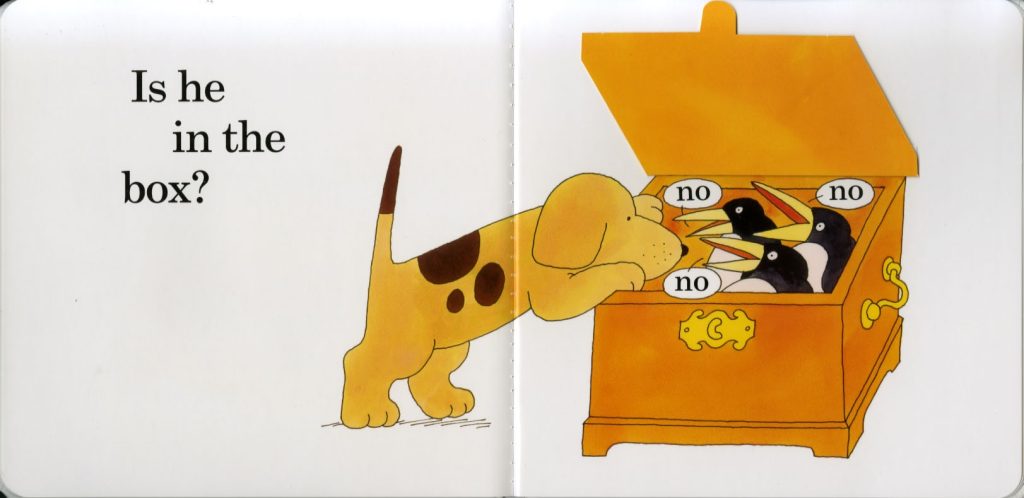
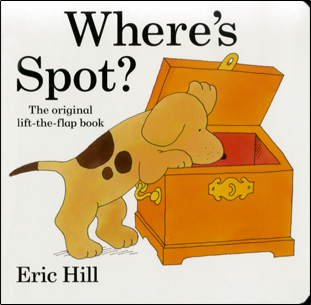
It is hard to believe that this pooch has only been around for thirty-one years. The ongoing saga of Spot began not with Spot himself, but his mother Sally. In Where’s Spot? published in 1980, Sally goes searching for her son. As this yellow dog, with brown spots and a distinctive brown-tipped tail, looks around the house, she opens a door to find . . . a bear. And then young readers lift several flaps in the book to see what Sally sees: a hippo in the piano, a monkey in the closet, and a turtle under the rug. Only in the end does Sally find the adorable Spot—nicely nestled in a basket.
Like many classics the book came about because of a child. Although never formally trained in art school, at fifteen Eric Hill studied informally with a cartoonist. While Hill was working as a freelance artist and designer, he noticed that his two-year-old son Christopher loved lifting flaps on the advertising pieces that Hill was creating. Hill had always been intrigued by the question of what his beloved dog actually did when the family left the house. He imagined that the dog had a secret life, never seen by owners. So in Where’s Spot? he explored the idea of dogs at home with no human intervention and an imaginative lift-the-flap game. The book became such an immediate success that Hill was able to create children’s books full time.
As a book for very young children, Where’s Spot? does so many things right. It helps with place identification and animal identification. It provides a repetitive story pattern and a guessing game. And using very few words, the book presents a small story arc—a beloved son is lost and finally found in a story under a hundred words. The art itself—clear and clean, with strong black outline and bright colors—has been showcased on bright thick stock, making it durable for the youngest reader. All the paper engineering details have been worked out brilliantly. Even on the first page, the flap can be lifted to put in the child’s name in “This book belongs to.” Perfect for shower gifts or the first book on a child’s bookshelf, the Spot series has been translated into sixty languages and sold over fifty million copies worldwide.
If you are buying books for a preliterate child, pick up Where’s Spot? It—almost—makes me long for another puppy!
Here’s a page from Where’s Spot?: