Over the last two months, we’ve been looking at some optimistic books about a child going back to school. Whether it is The Magic School Bus or Kindergarten Diary, these books end happily with their protagonists very satisfied to be in school.
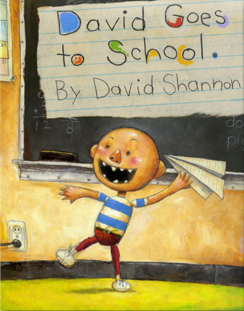
But for some children, school may be a bit more of a challenge. For teachers, these children can often prove trying. Later this month we will look at Jack Gantos’s Joey Pigza series. Today I’m going to focus on a character created by David Shannon, his alter ego, in David Goes to School.
We first meet young David in an earlier book, No, David! David Shannon actually wrote the first draft of this book when he was a child. His mother saved it and sent it to him years later. After looking at it, David decided that with a little alteration it would make a very good picture book. He writes “The text consisted entirely of the words no and David—they were the only words I knew how to spell—and it was illustrated with drawings of David doing all sorts of things he wasn’t supposed to do.”
In David Goes to School our hero, or anti-hero, finds himself in trouble again. Only this time the teacher tells him no—no yelling, no pushing, and no running in the halls. As she gives David a new set of commands (sit down, don’t chew gum, raise your hand, and pay attention), she spells out how to keep the classroom community in order. But David, unwilling and unable to obey the rules, acts out continually. When David has been told to pay attention, for instance, the illustration shows him gazing at the sky, where a large cloud shaped like a dinosaur lurks. In the end our bad boy has to stay after school and clean the desks. But the final lines give the reader—if not young David—some hope. “Good job, David! Yes, David….You can go home now.”
While adult readers might find themselves exhausted, feeling sorry for this poor teacher, children will see a bit of themselves—or at least enjoy watching a book character do what they might like to do. Grown-up David Shannon has executed the book with humor and an amazing memory of childhood. With fanglike teeth and a smile as wide as his face, David wins over all his readers in the end. And the book functions as a way to introduce basic school rules. For this very reason many teachers love to open the school year with it because the ending makes quite clear that although bad behavior will be scolded, good behavior will be praised.
Both in No, David! and David Goes to School, David Shannon has executed picture books that keep readers laughing from the first page to the last. He has clearly never forgotten what it feels like to be a child on those first days of school.
Here’s a page from David Goes to School: