


On September 2, 1850, Albert Goodwill Spalding was born on a farm in Byron, Illinois. As a boy he began to play baseball in boarding school, and as an adult he became one of the great pitchers in America. Spalding brought four pennants to his Boston Red Stockings club before he headed to the Midwest to play for the Chicago White Stockings. But today, of course, he is best remembered for his role as a sporting goods king, which made him a millionaire, and the Spalding baseball.
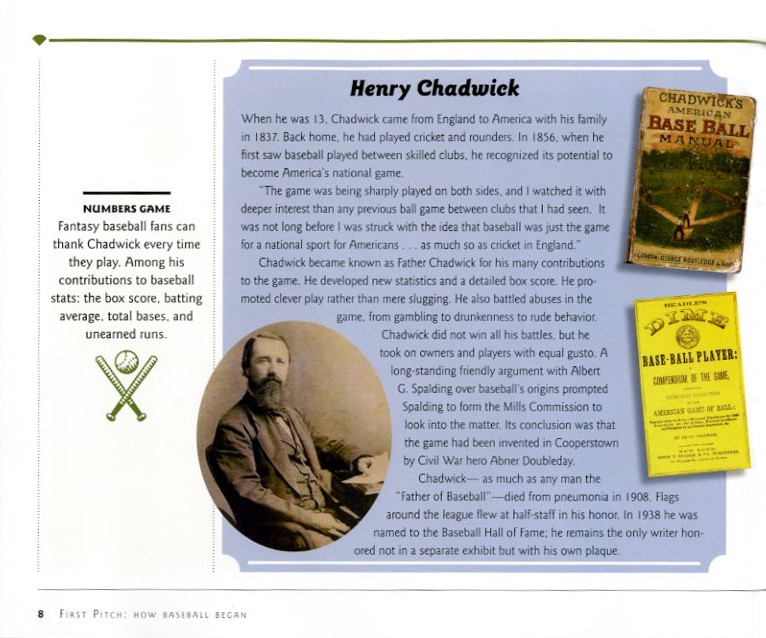
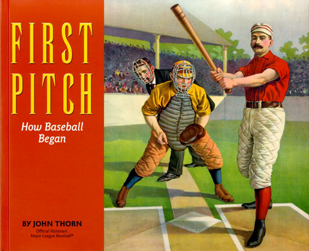
In First Pitch: How Baseball Began baseball historian John Thorn describes Spalding and a lot of other baseball legends to debunk the prevailing story that Abner Doubleday is the inventor of baseball. In 1905, Spalding appointed an elite group of baseball old-timers to determine the origins of the game. Unfortunately, the Special Commission on the Origin of Baseball made a mess of this assignment: they accepted the completely false story of a man named Abner Graves who credited Civil War General Abner Doubleday with inventing the national pastime.
Thorn continues the saga, providing evidence of the early origins of baseball and showing young readers how real research can be accomplished. It really doesn’t matter if you like baseball or not, this book presents a scholar’s journey to find the truth. Thorn takes readers through a score of primary documents, including a handwritten 1791 law from Pittsfield, Massachusetts that states “For the Preservation of Windows in the New Meeting House . . . no Person or Inhabitant of said town shall be permitted to play at any game called . . . Base Ball.” In the end, Thorn argues that the 1845 New York Knickerbockers might best be called the fathers of American baseball, as they put in place so many of the rules of the game we know today. Curses! New York triumphs once more in baseball over Massachusetts!
As Thorn builds his evidence, he weaves in information about American colonial life, the Civil War, even references to baseball in Jane Austen. The forty-page paperback published by Beach Ball Books has been beautifully produced with full-color art, sidebars, and a heavy paper cover with elegant flaps. Now the Official Historian of Major League Baseball, Thorn goes a long way in this book to entice young readers to think about baseball—and to think about the process of historical research. Anyone who wants to share the best narrative nonfiction with young readers will want to pick up a copy of First Pitch.
Here’s a page from First Pitch: