
As I mentioned yesterday, August serves as National Beach Month, reminding us to get out and enjoy this environment before the summer season ends. When I think of beaches, dogs instantly come to mind. But what if creatures we don’t normally associate with it inhabited the beach?
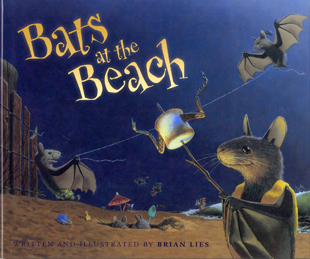
Incongruity, of course, can be one of the most powerful tools in the hands of a creative artist. Brian Lies, who has added his illustrative charm to a plethora of children’s books, brought together the beach and an unusual visitor. While his second-grade daughter was getting ready for the school bus one December morning, she pointed to a bumpy frost pattern on the window and said, “Look, Daddy. It’s a bat, with sea foam.” As soon as she was on the bus, he pulled out a yellow legal pad and started writing and drawing. Bats at the Beach begins with an inviting bat, surfing the waves. This version of the frost pattern on the window serves as Lies’s way of thanking his daughter for the idea behind the book.
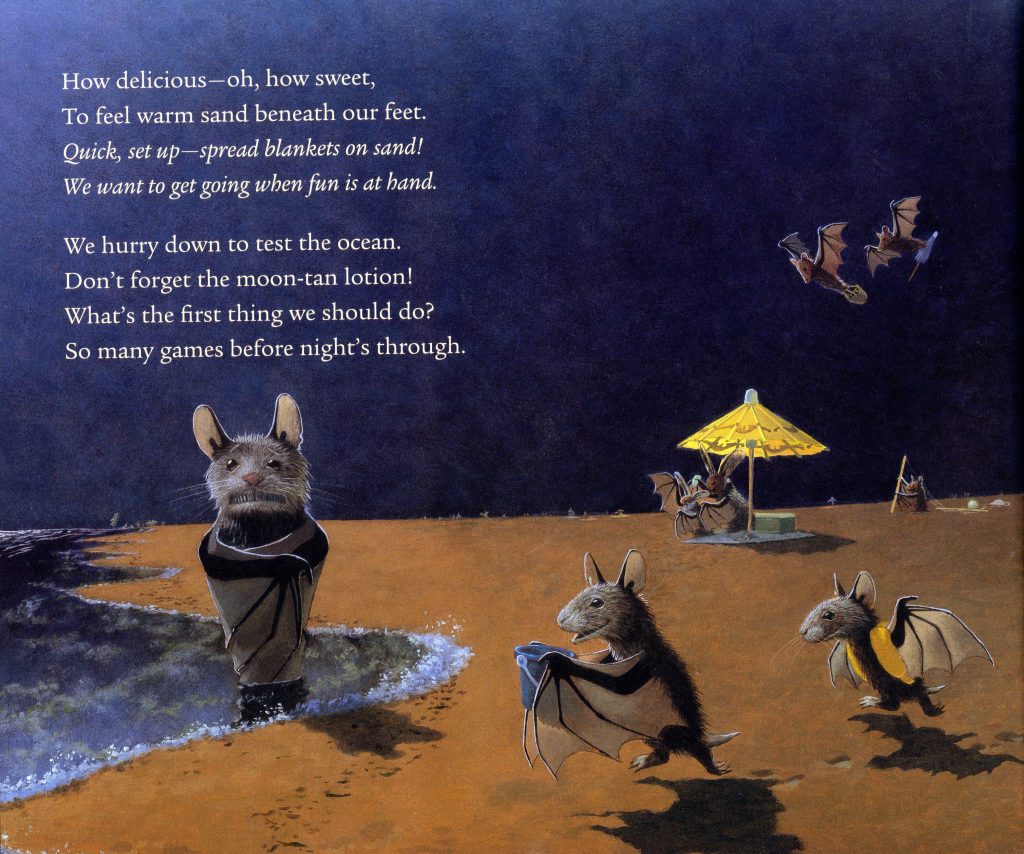
Against a dark blue night background, when “the moon is just perfect for bats at the beach,” the bats prepare for their outing just as human families do. Buckets, shovels, banjoes, blankets, books, and towels get strapped to their backs and under their wings before they fly off. The bats have all of the appropriate accoutrements—including moon-tan lotion—and they make creative use of what has been left behind by people that day. Bats fly each other as kites; they play volleyball; they slip notes in a bottle to go out to sea; and they use discarded cardboard cartons for boat races. Admittedly, most of their gastronomic fare sounds a bit repulsive—beetles, ants, moths, pickled slugs. But Lies remains true to bat behavior, even in fantasy. Certainly one of the most inventive picnic treats ever invented, bug-mallows toasted on slender sticks, looks familiar, although I don’t think I would eat one. When they head to the snack bar, they hang upside down and chase moths for desert. And, before the sun rises, these happy creatures head home, to sleep and dream about their experiences.
Every time I read this book, the bats’ adventures sound like such fun that I almost want to be a bat for an evening. If you go to the beach today, daylight hours will probably be best. But take along a copy of Bats at the Beach. This celebration of bats enjoying the simple pleasures of beach living will keep children ages three through eight laughing, turning the pages, and asking for it to be read again.
Here’s a page from Bats at the Beach: