
On November 17, 1820, Nathaniel Palmer and his men on the Hero became the first Americans to set foot on the Antarctic Peninsula. He was a young man, twenty-two, when he accomplished the act for which he has been immortalized.
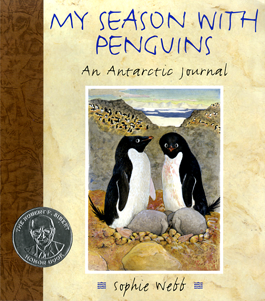
When I think of young Americans journeying to Antarctica, the book that instantly comes to mind is Sophie Webb’s My Season with Penguins: An Antarctic Journal, published ten years ago. Webb is a biologist and an artist who specializes in nature drawings. This forty-eight-page book, ideal for second through fourth graders, presents entries about her trip to McMurdo, one of the U.S. Antarctic Program’s bases. As she describes the base, it is “devoted to scientific research and exploration. An international treaty designates the Antarctic as a continent used only for peaceful purposes…. There are no territorial borders and no part of the Antarctic is owned by a country.”
Webb shows the extensive preparation required for a trip to the Antarctic: picking up clothing, finding the necessary gear, and attending survival school. In December the sun shines twenty-four hours a day, something hard for Webb to adjust to. As she and her fellow scientists set up camp, she shows the layout and gives the details children want to know: how bathrooms work in freezing temperatures! All of these steps in the process have been illustrated by Webb’s precise watercolor, gouache, and graphite illustrations.
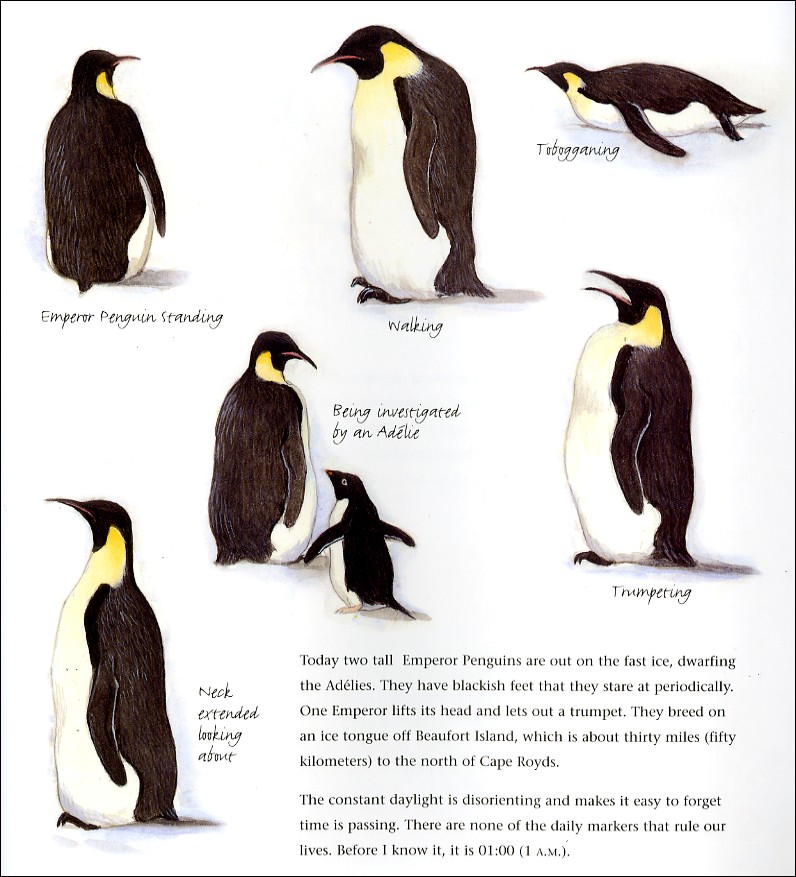
Then we come to my favorite part of this fascinating journal—pages and pages of drawings of Adelie Penguins, the true dwellers of the Antarctic. We see them in ecstatic display, tobogganing, incubating eggs, and greeting each other. Because Webb can control all aspects of the illustrations, these birds seem much more alive on the page than any photo or movie of them I have witnessed. Animated and vibrant, her illustrations make you feel as though you can actually reach out and touch these penguins.
The journal is both a record of what the scientists are doing, and of their subject, the penguins. A glossary provides more information about the birds and terms. Outside of the admirable Scientists in the Field series, it is difficult to find books that actually show what scientists do. This book provides a glimpse into the life of someone dedicated to science. It pleases penguin fanciers everywhere, and it shows a young woman making a contribution to our understanding of the natural world.
If you can’t travel to Antarctica in the next couple of months, pick up My Season with Penguins. It will make you feel as if you have been there.
Here’s a page from My Season with Penguins: