Daily children’s book recommendations and events from Anita Silvey.
Discover the stories behind the children’s book classics . . .
The new books on their way to becoming classics . . .
And events from the world of children’s books—and the world at large.
Find a Book!
Search the archives for recommendations by age group, book type, subject, date, and more.
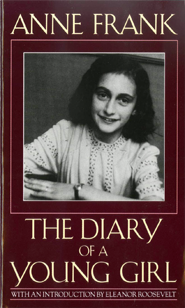
On August 1, 1944, a fifteen-year-old girl wrote what would be the last entry in a diary she had been keeping since June 14, 1942. Her outpourings in this diary over the course of more than two years were remarkable. In this final entry, she talked about her character, striving to become a better human being. “I’ve already told you before that I have, as it were, a dual personality. One half embodies my exuberant cheerfulness, making fun of everything…. I have another side, a finer and better side. I’m afraid they’ll laugh at me, think I’m ridiculous and sentimental, not take me seriously.” Today no one laughs at the character of this young woman; she has become the most widely read and most widely revered teenager of all time.
Shortly after this entry, on August 4, 1944, Nazi troops discovered the location of Anne Frank and her family, who had been hiding in a secret annex of an office building on Prinsengracht Canal in Amsterdam. Although all the human inhabitants of the annex disappeared that day, taken to concentration camps, Anne’s diary remained behind. When Anne’s father Otto Frank returned the next year, the only one of the eight in hiding to survive, he found her diary in a desk. Surprised by the complexity and depth of Anne’s writing, he typed a copy, cutting about a third of the content, and circulated it among friends.
At first German publishers turned down the project, but eventually one took a chance on it in 1947, issuing only fifteen hundred copies. Five years later, after several U.S. publishers passed on the book, Doubleday released an edition in the United States with a stirring introduction by Eleanor Roosevelt. Adults expressed concerned that the content would be too emotionally difficult for teens and children, but young readers disagreed. They found in Anne a kindred spirit. When I read this book in sixth grade, I felt as if I, myself, were living in the annex. Anne seemed like the kind of friend I would want to have. In many ways an exceptional teenager, Anne lived in extraordinary times. Her diary shows not only the plight of those threatened with death, but also domestic life and squabbles, common adolescent problems, and an examination of moral issues. And, in the end, it shows her idealism triumphing over despair.
Today a complete edition of the diary exists, made available in 1995 by the Anne Frank Foundation. Whatever version you read, The Diary of a Young Girl can be shared in the classroom, with a family, or for independent reading. With more than fifteen million readers worldwide, the diary eventually fulfilled one of Anne’s greatest dreams: “I want to go on living even after my death.”
Here’s a passage from The Diary of a Young Girl:
It’s a wonder that I haven’t abandoned all my ideals; they seem so absurd and impractical. Yet I cling to them because I still believe, in spite of everything, that people are truly good at heart. It’s utterly impossible for me to build my life on a foundation of chaos, suffering, and death. I see the world being slowly transformed into a wilderness. I hear the approaching thunder that, one day, will destroy us too. I feel the suffering of millions. And yet, when I look up at the sky, I somehow feel that everything will change for the better, that this cruelty too will end, and that peace and tranquility will return once more.
Also recommended:
Additional Information
A few other events for
- Happy birthday Joyce McDonald (Swallowing Stones, Shades of Simon Gray), Nancy White Carlstrom (Jesse Bear series, This is the Day), and Laurence Anholt (Leonardo and the Flying Boy, Chimp and Zee).
- Birthday wishes to U.S. President Barack Obama (Of Thee I Sing: A Letter to My Daughters).
- It’s the birth date of poet Percy Bysshe Shelley (1792-1822). Read Wildly Romantic: The English Romantic Poets: The Mad, the Bad, and the Dangerous by Catherine M. Andronik.
- Jazz musician Louis Armstrong (1901-1971) was born on this day, as was mathematician John Venn (1834-1923), inventor of the Venn diagram. Read When Louis Armstrong Taught Me Scat by Muriel Harris Weinstein, illustrated by R. Gregory Christie, and That Is Not My Hat by Cecilia Venn, photographs by Dorothy Handelman.