
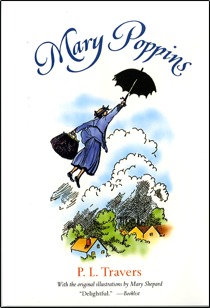
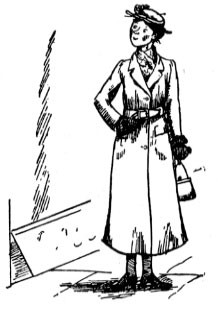
On November 13, 1926, a short story appeared in a New Zealand newspaper, the Christchurch Sun, by a young writer, who had emigrated to England from Australia. It recounted the saga of an “underneath nurse” age seventeen, and her charges Jane, Michael, Barbara, and John. On a day out, she puts on gloves, tucks a parrot-headed umbrella under her arm, and meets Bert, a pavement artist. This story eventually became part of a book published eight years later—P. L. Travers’s now-classic Mary Poppins.
If you know Mary only through her interpretation in the Walt Disney movie, you have missed one of the great characters in children’s literature. Conventional wisdom says that young readers focus only on the children in their fiction, having little use for the adults. But Mary Poppins is one of the exceptions to that rule. Salty, mysterious, vain, sharp of tongue, and independent in the extreme, Mary makes life in the Banks household very exciting for her young charges. They encounter an ancient candy storeowner, whose self-regenerating fingers happened to be made of barley sugar; she levitates everyone so that they have tea parties on the ceiling; and she can speak to the animals and interpret animal speech. In fact, she supports anarchy and defies authority every moment of her life as a nanny. Anita Diamant, author of The Red Tent, was just one of many children inspired by Mary Poppins: “I never wanted Mary Poppins to be my nanny. I wanted to be Mary Poppins when I grew up.” (from Everything I Need to Know I Learned from a Children’s Book)
I actually met P. L. Travers on her last tour to America, and I am happy to report that she herself was as sharp-tongued and eccentric as her beloved character. “I don’t write for children at all. I turn my back on them,” she once said. Fortunately, young readers have never agreed with her. So happy birthday Mary Poppins—may you have many, many more.
Here’s a passage from Mary Poppins:
The wind, with a wild cry, slipped under the umbrella, pressing it upwards as though trying to force it out of Mary Poppins’s hand. But she held on tightly, and that, apparently, was what the wind wanted her to do, for presently it lifted the umbrella higher into the air and Mary Poppins from the ground. It carried her lightly so that her toes just grazed along the garden path. Then it lifted her over the front gate and swept her upwards towards the branches of the cherry-trees in the Lane.