Daily children’s book recommendations and events from Anita Silvey.
Discover the stories behind the children’s book classics . . .
The new books on their way to becoming classics . . .
And events from the world of children’s books—and the world at large.
Find a Book!
Search the archives for recommendations by age group, book type, subject, date, and more.


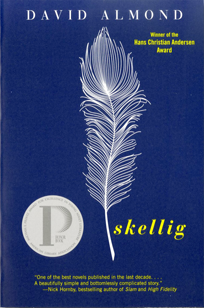
July has been designated Make a Difference in the Life of a Child month. The right book for the right child at the right time always has and always will change lives. The book of the day is one that can be very powerful when it gets in a child’s hands at the right moment. However, David Almond’s Skellig is one that got away from me as a publisher. I first saw the manuscript when I was working at Houghton Mifflin, and we had only a few days to decide if we wanted to place a bid to publish the book as it was being auctioned. Normally, I avoided auctions like the plague, but I thought David Almond’s Skellig one of the most brilliant manuscripts I had ever read. We placed a bid but Delacorte won the auction—they published the book well and have just given it an intriguing new paperback cover.
Ideal for ten- to fourteen-year-olds, Skellig tells the story of ten-year-old Michael, who is moving with his family into a new house in England. There’s a baby, as yet unnamed, in the family, but she has been in and out of the hospital, hanging tentatively on to life. So besides the normal moving worries, Michael must deal with a loving but preoccupied mother and father who have to focus on taking care of a sick infant.
In the new house’s dilapidated, collapsing garage, Michael stumbles upon an old man, half dead, who the boy secretly begins to feed and care for. Eventually he tells his new neighborhood friend, Mina; she is the only person he trusts with his secret. For Skellig, as the man calls himself, may not be a mortal man at all. At one point, Mina and Michael discover that he has wings—and in a magical scene he takes them flying. Owls also feed Skellig, although he seems to prefer Michael’s Chinese takeout. He mumbles and rants, but he also makes sense at the same time.
The book alternates between the almost dreamlike sequences where Michael deals with Skellig, and the realistic chapters focusing on his school and the baby’s declining health. During the day-to-day events, Mina tells Michael about William Blake. Skellig is just the kind of creature Blake would invent.
Finally, the two parts of the story intertwine, when Michael’s mother dreams of Skellig visiting the baby in the hospital. The baby begins to mend—and Skellig bids farewell to his friends who have brought him back to life.
A book of magical realism, Skellig does not read like any other novel written for children. It explores the healing power of love and a sense of spiritual wonder. Although it can be enjoyed for independent reading, it begs for a book discussion group so that everyone can talk about their own understanding of its contents. My sense of the book changes each time I read it. However the reader experiences Skellig, it remains one of those haunting, amazing novels for children that can be appreciated as much by the adults who find it.
Here’s a passage from Skellig:
“Let me sleep,” squeaked Skellig. “Let me go home.”
He lay facedown and his wings continued to quiver into shape above him. We drew the blankets up beneath them, felt his feathers against the skin on the backs of our hands. Soon Skellig’s breathing settled and he slept. Whisper rested against him, purring.
We stare at each other. My hand trembled as I reached out toward Skellig’s wings. I touched them with my fingertips. I rested my palms on them. I felt the feathers, and beneath them the bones and sinews and muscles that supported them. I felt the crackle of Skellig’s breathing.
I tiptoed to the shutters and stared out through the narrow chinks.
“What you doing?” she whispered.
“Making sure the world’s still really there,” I said.
Additional Information
A few other events for
- Happy birthday Charlotte Pomerantz (The Piggy in the Puddle) and Sherry Garland (The Lotus Seed, Shadow of the Dragon).
- It’s the birth date of Esther Averill (1902-1992), The Fire Cat.
- It’s also the birth date of aviator Amelia Earhart (1897-1939). Hence, is it Amelia Earhart Day. Read Amelia and Eleanor Go For a Ride by Pam Muñoz Ryan, illustrated by Brian Selznick.
- Happy birthday to Detroit (1701), founded in what would eventually become the state of Michigan. Read Antoine de la Mothe Cadillac: French Settlements in Detroit and Louisiana by Anders Kundsen and These Hands by Margaret H. Mason, illustrated by Floyd Cooper.
- It’s Tell an Old Joke Day. Read Old Turtles 90 Knock-Knocks, Jokes, and Riddles by Leonard Kessler.