
Seventy years ago in 1941, three days before Hitler’s army marched into Paris, two German Jews who had come to the city on a honeymoon and stayed for a couple of years, found themselves trapped in Paris. Although Hans and Margret Rey had secured railroad tickets, the trains stopped running. So Hans scoured bicycle stores, but found all the bicycles had already been sold. He purchased spare parts and fashioned something for them to ride that resembled a bicycle. On June 12 they headed out of Paris, with only some book manuscripts and their winter coats, in an attempt to evade the Germans.
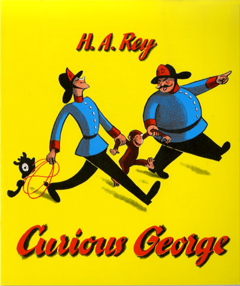
For about a week they stayed two days ahead of the invading troops—peddling by day, sleeping in the fields at night. At one point, a border guard stopped them and asked the man what he did. “I create children’s books,” Hans Rey said. Asking to see one of the books, the guard smiled at the manuscript presented to him: “My children would like this…you can continue.” That day Hans and Margret Rey’s lives were spared because of a story about a mischievous monkey named Curious George. To be accurate, their lives were saved by a monkey named Fifi, whom Margret Rey served as the model for and who was later renamed “George.”
Brazilian passports got them out of France and America’s Good Neighbor Policy made it possible for them to come to New York. Without resources, they frantically contacted their British editor, who as luck would have it now directed the children’s book department of Houghton Mifflin in Boston. To help these struggling refugees, Grace Hogarth gave them a four-book contract—thereby paying $250 in advance for a book that still sells millions of copies every year. She and the Reys decided to publish Curious George right away; in time George became one of our most beloved American icons. With endless capacity to get into trouble, Curious George serves as the alter ego for so many preliterate children who would love to behave just like George does. Fortunately, George is always rescued by the man in the yellow hat.
I had the privilege of working with both the Reys. Margret lived to be ninety, and I would sit with her, in her home in Cambridge, Massachusetts, decorated as a shrine to George—with books, stuffed toys, and various replicas in all forms. She would look in wonder around her and say, “It is so hard to believe that all of this came from that manuscript we brought from Paris so many years ago.” No story demonstrates the miracle of children’s books as much as Curious George. No matter how, where and when great children’s books begin, or their trials on the way to publication—they can reach across generations, across time and history, to speak to the children born today. So I’d like to take a moment on this day to honor my friends Hans and Margret. I am so grateful that they escaped Paris seventy years ago.
Here’s a page from Curious George:
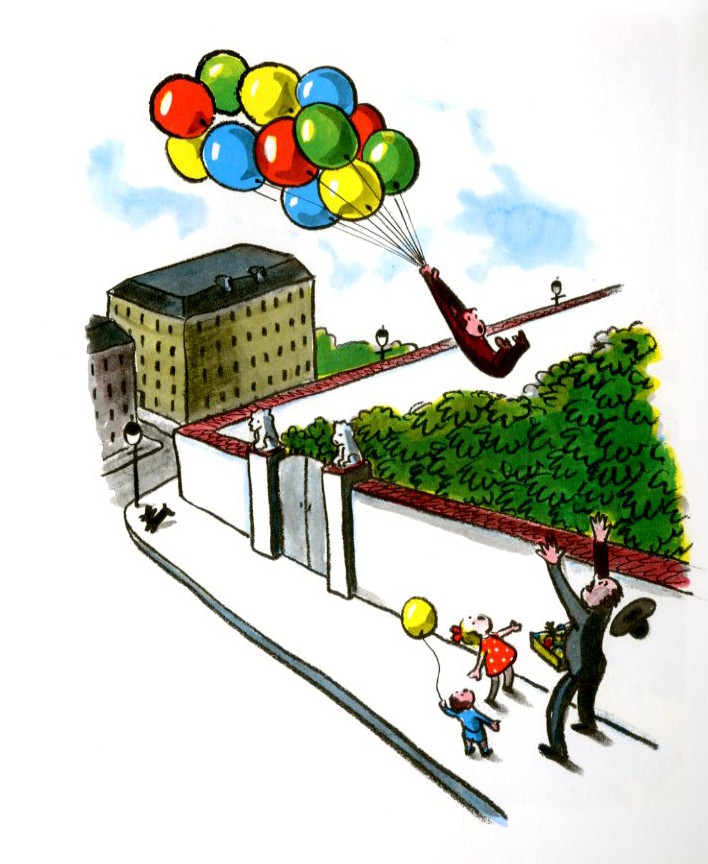
and, with them, went George,
holding tight with both hands.