
Today marks the birthday of someone who might best be described as the father of the American picture book—or, probably today, its grandfather. When Maurice Sendak published his masterpiece, Where the Wild Things Are, in 1963, he changed the scope and the possibilities of the picture book for every artist to come after him. He gave shape to the imagination and fantasies of children, and he became the friend of millions of young readers who knew he completely understood them.
In all of his books, Sendak explored his own inner landscape, one that is idiosyncratic and personal. Because of his honesty and because he never forgot the feelings and emotions of childhood, children can completely identify with his characters. As Sendak once wrote, “children live on familiar terms with disrupting emotions….They continually cope with frustration as best they can. And it is through fantasy that children achieve catharsis. It is the best means they have for taming Wild Things.”
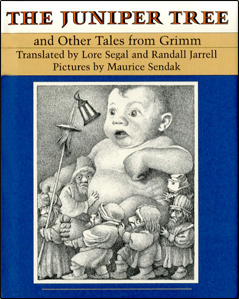
In almost sixty years of creating books, from his first written by Ruth Krauss, A Hole Is to Dig, to his last book BUMBLE-ARDY, Sendak sought to portray something other than the “All-American, white-toothed” kids found so prevalently in children’s books. His models were the children he saw in the streets of Brooklyn, where he grew up and lived—immigrants from Poland and other countries, squat, solid, individual beings. Sendak has fashioned one remarkable book after another, including his illustrations for The Juniper Tree and Other Tales from Grimm, translated by Lore Segal and Randall Jarrell, the best volume of Grimm published for children.
After illustrating more than fifty books, in November of 1955 Sendak began his own story, initially called “Where the Wild Horses Are.” Unfortunately, he couldn’t draw horses and had to find another subject. Then the phrase “Wild Things” came to him. Sendak threw memories of King Kong into the story cauldron. As he drew and redrew his creatures, the skinny beings gained weight and density. In the resulting story the hero Max rages against his mother for being sent to bed without supper. Max’s bedroom becomes a forest where he meets, tames, and becomes king of the Wild Things. Through his fantasy, Max works out his anger against his mother and returns to the real world, at peace with himself.
Sendak uses a mere 338 words to tell the story; the pictures, which allow children to build their own fantasy, fill in the rest of the narrative. As Max’s emotions swell, the art takes up more and more space on the page, until the center, a double-page spread where he parades as king of the Wild Things. Sendak’s editor for the book, Ursula Nordstrom, always said that he created art with the “hand of God.” Winner of the Caldecott Medal in 1964, recently adapted for a movie, Where the Wild Things Are has become part of the American conscience, the birthright of every child.
When Maurice died this year, the media was filled with praise for his work and stories about his impact on the lives of readers of all ages. When it cane to picture books, he had no equal; he was in a class by himself.
Here’s a page from The Juniper Tree:
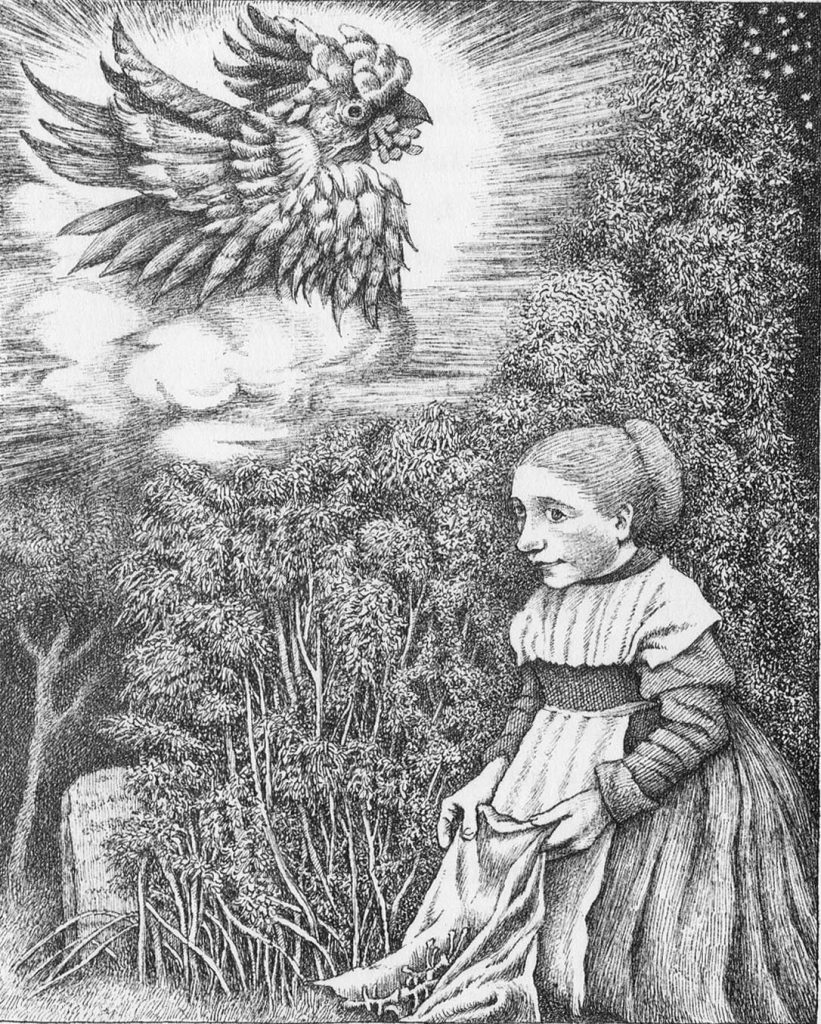
And then there was a sort of mist coming out of the tree and right in this mist it burned like fire and out of the fire flew this lovely bird that sang oh, so gloriously sweet and flew high into the air and when it was gone the juniper tree was just the way it had always been.