Daily children’s book recommendations and events from Anita Silvey.
Discover the stories behind the children’s book classics . . .
The new books on their way to becoming classics . . .
And events from the world of children’s books—and the world at large.
Find a Book!
Search the archives for recommendations by age group, book type, subject, date, and more.
Today has been designated Brother’s Day—a celebration of brotherhood for biological brothers, fraternity brothers, and brothers bonded by union affiliation or lifetime experience. As could be predicted, children’s books frequently focus on sibling relationships, both brothers and sisters. After all, in childhood these relationships loom large in our lives.
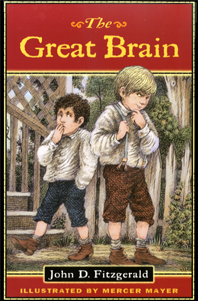
When I think of brothers in children’s books, to my mind the best series was published more than forty years ago, beginning with John D. Fitzgerald’s The Great Brain. In the 1950s Fitzgerald had written adult fiction, Uncle Will and the Fitzgerald Curse, Papa Married a Mormon, and Mama’s Boarding House. But then he began writing about the children of Adenville, Utah, at the turn of the twentieth century. For these eight novels, he drew loosely on his own childhood experience.
In The Great Brain, narrated by young John Dennis Fitzgerald, we see his two older brothers through his eyes. Sweyn Dennis (all the boys have Dennis as a middle name) makes a cameo appearance. But Tom Dennis, aka the Great Brain, is the focus of the novel. For Tom is a smooth-talking, silver-tongued con artist—and loves to find any scheme that he can to relieve the children, and even parents, of Adenville, of their hard-earned money. Whether Tom is charging the children a penny to look at the family’s indoor water closet (the first indoor toilet in the neighborhood) or negotiating deals to breed John’s dog, he always finds a way to come out on top—usually at John’s expense. But Tom can also be compassionate. He helps a Greek immigrant assimilate into the community and shows a boy who has lost part of a leg how to recover emotionally and physically from his disability. The books bring to life the community of Adenville, Utah. Most people are Mormon, but some are Catholics and Protestants. Religious tension and conflict rarely get explored in children’s books, but the Great Brain books continually discuss this reality—even showing how religious prejudice brings about the death of an itinerant Jewish peddler.
In the end, these books, ideal for seven- to ten-year-olds, celebrate brothers—caring, scraping, devoted brothers. So celebrate Brother’s Day by acknowledging the brothers in your life—and by picking up The Great Brain and its sequels.
Here’s a passage from The Great Brain:
I followed Tom out to our backyard because I knew what he was going to do. His great brain had long ago figured out a way to eavesdrop on anybody in our parlor. We were without a doubt the best-informed kids in town on things parents didn’t want their children to hear.
I watched Tom climb up to the roof of our back porch and then crawl up the edge of the roof until he was on top of the house. I held my breath as he stood up like a tightrope walker and walked across the pointed top of the roof until he came to the chimney for the fireplace in our parlor. He got hold of the top of the stone chimney and, using a crack for a footrest, hoisted himself up until his head was above the chimney. My brother had told me the stone chimney of the fireplace magnified voices in our parlor so he could hear every word spoken.
Also recommended:
- All the books in the Great Brain series by John D. Fitzgerald
Additional Information
A few other events for
- Happy birthday Diane DeGroat (Roses Are Pink, Your Feet Really Stink) and Candace Fleming (Clever Jack Takes the Cake).
- It’s the birth date of Martha Alexander (A, You’re Adorable) and Elizabeth Foreman Lewis (1892-1958) Yong Fu of the Upper Yangtze.
- Best birthday wishes to singer Bob Dylan. Read Forever Young by Bob Dylan, illustrated by Paul Rogers, and Man Gave Names to All the Animals by Bob Dylan, illustrated by Jim Arnosky, and When Bob Met Woody: The Story of the Young Bob Dylan by Gary Golio, illustrated by Marc Burckhardt.
- In 1830, Mary Had a Little Lamb by Sarah Josepha Hale is first published. Read Thank You, Sarah: The Woman Who Saved Thanksgiving by Laurie Halse Anderson.