

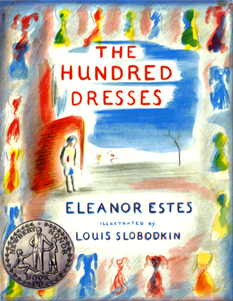
Born on May 9, 1906, in West Haven, Connecticut, Eleanor Estes worked in the New York Public Library until her first book, The Moffats, was published in 1941. Although she won the Newbery Award for Ginger Pye in 1951, Estes’s earlier book, The Hundred Dresses, has emerged as one of our most unusual and powerful classics.
In print since 1944, this eighty-page novel addresses one of our current societal concerns: bullying. Even when approaching this serious subject, Estes does so with a lightness of touch that has caused The Hundred Dresses to be used in classrooms from elementary through high school. In the thirty-two-page manuscript, Estes also tackles the subjects of social class and money. Louis Slobodkin added spot art and occasionally double-page illustrations. Winner of a 1944 Caldecott Medal for James Thurber’s Many Moons, Slobodkin draws a mere suggestion of the characters allowing readers to imagine other faces on them.
In The Hundred Dresses a group of fourth grade girls tease and torment one of their classmates, a poor Polish girl named Wanda Petronski who wears the same dress to school every day. But Wanda claims to have a hundred dresses. Peggy, a wealthy, cruel bully, encourages her sidekick, Maddie, to torment Wanda. Insecure and depending on Peggy’s hand-me-down clothes, Maddie acts in ways not consistent with her own sense of morality. She knows that harassing Wanda is wrong, but she does not want to alienate Peggy. Rather than telling the book from Wanda’s point of view, Estes focuses on Maddie. Consequently, readers see the effect of bullying on those who engage in it.
In the end, Wanda does possess a hundred dresses—ones she has drawn herself. And Maddie, feeling tremendous remorse, does not have a chance to apologize or make her actions right. She must now live with what she has done and her sense that she has not treated others as she herself would like to be treated. The reader feels guilt and remorse along with the main characters making this title a first choice for guidance counselors when addressing the issue of bullying.
The Hundred Dresses reminds us that childhood bullying is not a new phenomenon—and that those who seem different can become easy targets in classrooms. After all these years, it remains a three-handkerchief book—one that touches children emotionally as they confront its important and significant content.
Here’s a section from The Hundred Dresses: 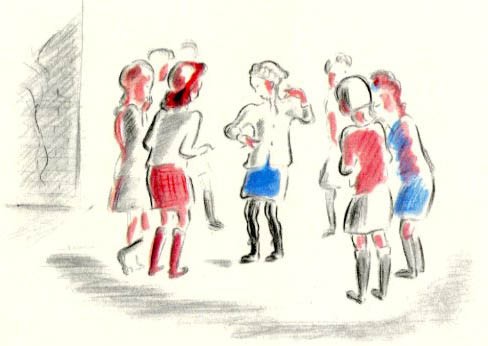
Then the outer fringe of the crowd of girls would break away gradually, laughing, and little by little, in pairs, the group would disperse. Peggy, who had thought up this game, and Maddie, her inseparable friend, were always the last to leave. And finally Wanda would move up the street, her eyes dull and her mouth closed tight, hitching her left shoulder every now and then in the funny way she had, finishing the walk to school alone.
Peggy was not really cruel. She protected small children from bullies. And she cried for hours if she saw an animal mistreated. If anybody had said to her, “Don’t you think that is a cruel way to treat Wanda?” she would have been very surprised. Cruel? What did the girl want to go and say she had a hundred dresses for? Anybody could tell that was a lie. Why did she want to lie? And she wasn’t just an ordinary person, else why would she have a name like that? Anyway, they never made her cry.
As for Maddie, this business of asking Wanda every day how many dresses and how many hats and how many this and that she had was bothering her. Maddie was poor herself. She usually wore somebody’s hand-me-down clothes. Thank goodness she didn’t live up on Boggins Heights or have a funny name. And her forehead didn’t shine the way Wanda’s round one did.