Daily children’s book recommendations and events from Anita Silvey.
Discover the stories behind the children’s book classics . . .
The new books on their way to becoming classics . . .
And events from the world of children’s books—and the world at large.
Find a Book!
Search the archives for recommendations by age group, book type, subject, date, and more.
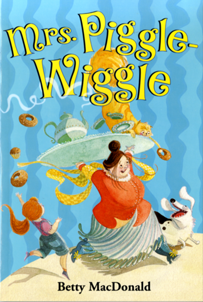
On March 26, 1908, Betty MacDonald was born in Boulder, Colorado. Because her father worked as a mining engineer, she spent many years of her childhood traveling around the West. Eventually settling in Seattle, MacDonald attended the University of Washington and wrote The Egg and I, a funny account of her married life on a chicken farm.
As accomplished as her adult books were, MacDonald is remembered and celebrated for her series of books for children ages six through ten about a charming, but no-nonsense widow who lives in a small town named Mrs. Piggle-Wiggle. Although experts like to say that children want to read books only about other children and are not interested in adults, Mrs. Piggle-Wiggle is an exception to that rule. She loves children and entertains them in a house she has turned upside down. To these young people she gives sound advice about living with and understanding parents.
The first volume in the series, Mrs. Piggle-Wiggle, appeared in 1947; the fourth, Hello, Mrs. Piggle-Wiggle, in 1957. At this time most parents got child-raising wisdom from Dr. Spock, but it probably would have been better for them to have consulted Mrs. Piggle-Wiggle instead. The books present a variety of children with different kinds of behavior problems. Mrs. Piggle-Wiggle considers these problems ailments or diseases that, just like the measles, need only to be cured. Although some of her solutions involve magic, most have been grounded in an understanding of children and common sense.
Children enjoy reading about these young monsters in the making, who act out in horrible ways. Adults appreciate the happy resolution of each case study, with the family restored to harmony. In fact, Mrs. Piggle-Wiggle believes that everyone in the family really wants harmony. So when two girls fight and quarrel, she advises the adults to engage in the same behavior. Genuinely horrified by watching their parents fight, the girls begin to treat each other with respect, and the family heads out for ice cream sodas to celebrate.
An ideal chapter book for children who have just learned to read, each chapter works as a self-contained unit, with a beginning, middle, and end. The pattern of the stories repeats in each chapter, so children quickly feel competent in understanding what will come next. Originally Hilary Knight and Maurice Sendak, illustrating superstars, added their interpretations to the stories. The 2007 reissue of these books contains the more modern artwork of Alexandra Boiger. Certainly reflections of their times, the books deal exclusively with the problems of two-parent families and present old-fashioned gender roles. But often when I ask people about the most important books of their childhood, someone in the audience always pipes up and says, “Mrs. Piggle-Wiggle.”
Happy birthday Betty MacDonald. Your books, in print for nearly sixty-five years, have made many laugh and many want to read more. How I wish that I could play today at Mrs. Piggle-Wiggle’s upside down house.
Here’s a passage from Mrs. Piggle-Wiggle:
Mrs. Piggle-Wiggle says that when she was a little girl she used to lie in bed and gaze up at the ceiling and wonder and wonder what it would be like if the house were upside down. And so when she grew up and built her own house she had it built upside down, just to see. The bathroom, the kitchen and the staircase are right side up—they are more convenient that way. You can easily see that you could not cook on an upside-down stove or wash dishes in an upside-down sink or walk up upside-down stairs.
Other books for this day
Also recommended:
- All the Mrs. Piggle-Wiggle series, particularly Mrs. Piggle-Wiggle’s Farm
Additional Information
A few other events for
- Happy birthday T. A. Barron (The Lost Years of Merlin), Julie Danneberg (First Day Jitters), and Jerry Pallotta (Apple Fractions).
- It’s the birth date of Robert Frost (1874–1963). Read Stopping By the Woods on a Snowy Evening illustrated by Susan Jeffers.
- In 1830, The Book of Mormon was published in Palmyra, New York. Read Nauvoo: Mormon City on the Mississippi River by Raymond Bial.
- The groundbreaking ceremony for Vietnam Veterans Memorial was held in Washington D.C. on this day in 1982. Read The Wall by Eve Bunting, illustrated by Ronald Himler.
- It’s Make Up Your Own Holiday Day.