Daily children’s book recommendations and events from Anita Silvey.
Discover the stories behind the children’s book classics . . .
The new books on their way to becoming classics . . .
And events from the world of children’s books—and the world at large.

Find a Book!
Search the archives for recommendations by age group, book type, subject, date, and more.


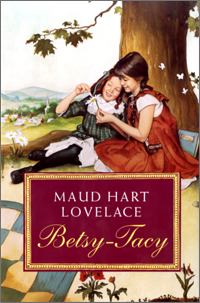
The first week of February has been designated as a week to celebrate children’s authors and artists. Of course, at the Children’s Book-A-Day Almanac, we do that 365 days a year. But since there are some fabulous children’s book creators that I’ve not yet had a chance to talk about, I’ll focus on some of them this week, beginning with Maud Hart Lovelace. Born in 1892 in Mankato, Minnesota, Lovelace began to write at an early age. She once asked her mother, “How do you spell ‘going down the street’?” She kept scrapbooks and diaries and later used this material for her books. At a time when women rarely received a college education, Lovelace attended the University of Minnesota, and she married another writer. Then she began to publish historical novels for adults such as Early Candlelight, which is set in Minnesota, and Gentleman from England, which she wrote with her husband.
Had she simply written adult novels, Lovelace would be forgotten today. Like many parents, she liked to tell her children stories about her own childhood home and friends. She told her daughter Marien stories about growing up in Mankato and her best friend Bick Kenney, whom she met at her fifth birthday party. Lovelace drew on these memories for a series of books presenting the adventures of three friends, Betsy, Tacy, and Tib, in Deep Valley, Minnesota. When a new family moves into Betsy’s neighborhood, she finally has a friend her age to play with. In fact, they do so much together that everyone simply refers to them as Betsy-Tacy.
Drawing many of the people and events from her life in Mankato, Lovelace aged her protagonists from age five to twelve in the first four books. The Betsy-Tacy series explores childhood and adolescence at the turn of the twentieth century in a small Midwestern community. The last six books in the series take the girls through high school and adult years. J. K. Rowling was not the first author to age her protagonist over a series of books—she just returned to an early twentieth century model for the Harry Potter series.
In these light-hearted, very enjoyable books for seven- to ten-year-olds, Lovelace introduced difficult issues. In Betsy-Tacy, published in 1940, Tacy’s baby sister dies, and as a five-year-old she must cope with her grief. In later Betsy-Tacy books and in a later novel, Emily of Deep Valley (1950), the characters must deal with small-town prejudice against the ethnic community Little Syria.
Acclaimed children’s writer Mitali Perkins expressed her enthusiasm for Lovelace in a new edition of Emily of Deep Valley: “Maud Hart Lovelace’s classic novels served as a superb orientation for a young newcomer from India eager to understand the history and heritage of a new world. They took me back to 1912, a time when America shared many of the values that resonated in my old-world home, but they also sparkled with timeless humor that made me laugh out loud in the library.”
Like many of our classics, the Betsy-Tacy books went out of print for a short period. But the Betsy-Tacy Society and the Maud Hart Lovelace Society kept the fans organized and managed to get the titles back in print. Although the books reflect their period, they remain true to the experience of many children who see their lives in terms of family and friendship. Long after other books have been forgotten, adults cherish their memories of reading about Betsy, Tacy, and Deep Valley.
Here’s a selection from Betsy-Tacy:
That summer they started having picnics. At first the picnics were not real picnics; not the kind you take out in a basket. Betsy’s father, serving the plates at the head of the table, would fill Betsy’s plate with scrambled eggs and bread and butter and strawberries, or whatever they had for supper. Tacy’s father would do the same. Holding the plate in one hand and a glass of milk in the other, each little girl would walk carefully out of her house and down the porch steps and out to the middle of the road. Then they would walk up the hill to the bench were Tacy had stood the first night she came. And there they would east supper together.
Also recommended:
- Emily of Deep Valley by Maud Hart Lovelace and Maud Hart Lovelace's Deep Valley: A Guidebook of Mankato Places in the Betsy-Tacy Series by Julie A. Schrader
A few other events for
- Happy birthday Jerry Spinelli (Stargirl), James Preller (A Pirates Guide to First Grade) and, Meg Cabot (The Princess Diaries)
- It’s the birth date of Langston Hughes (1902–1967), Poetry for Young People.
- On this day in 1861, President Abraham Lincoln signs the 13th Amendment, abolishing slavery.
- The first volume of the Oxford English Dictionary (A to Ant) is published in 1884.
- Four African American students from a North Carolina college stage the first Greensboro lunch counter sit-in at a Woolworths in 1960. Read Freedom on the Menu: The Greenboro Sit-Ins by Carole Boston Weatherford and illustrated by Jerome Lagarrigue.