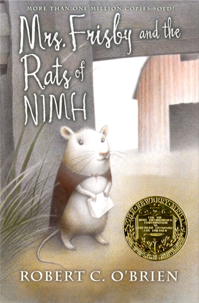
Today marks the birthday of one of the most reclusive children’s book authors of the 20th century. He was not so, however, because of his personality or because he did not want to engage with children. Robert Leslie Conly was born in Brooklyn in 1918; he studied English at the University of Rochester. Working for magazines his entire life, he wrote for Newsweek before joining the staff of National Geographic.
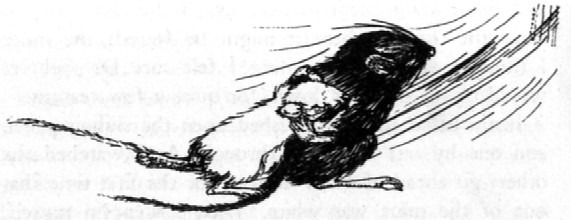
But in the late 1960s, Conly wrote three books for children. His work arrangement with National Geographic, however, forbid him from publishing with any other company. So he did what many authors have done before, he printed his books under a pseudonym—Robert C. O’Brien, based on his mother’s name. He also made no appearances on behalf of his books, to protect his true identity. His second book, Mrs. Frisby and the Rats of NIMH, combines talking-animal fantasy with science fiction. When dear Mrs. Frisby, a widowed mouse, learns that her own home may soon be destroyed by a plow, she attempts to move her sick son to safety. As a last resort, she consults the rats that live under the rosebush. These super intelligent laboratory rodents had been fed mind-enhancing drugs. One of them, Nicodemus, narrates how he and the other rats, part of an experiment in the National Institute of Mental Health, learned to read and finally escape to form a brave new rat world. “By teaching us how to read, they taught us how to get away.” This story works both as adventure but also as an exploration of what constitutes intelligence and community.
Mrs. Frisby and the Rats of NIMH often lingers in the mind of its readers. British journalist Lucy Mangan read the book when she was nine, and “it rocked my world. Everything I took for granted only existed because it was built or organized by us, because we were here first. But it could have been so different.” (Everything I Need to Know I Learned from a Children’s Book.)
When Mrs. Frisby and the Rats of NIMH won the Newbery Medal in 1972, O’Brien faced a real dilemma. As part of winning the award, he was expected to appear at the annual ALA conference and give a speech. In the end, he sent his editor Jean Karl with his comments and remained anonymous until his death in 1973. Then his wife and daughter Jane finished his last book, Z for Zachariah.; only after he died did his readers learn his true identity.
I always think Robert C. O’Brien should be the patron saint of shy children’s book authors and illustrators. Without book tours, media interviews, talking to children, or any form of personal marketing, O’Brien gained his following simply through writing one of the great fantasy/science fiction stories of the modern era.
So happy birthday Robert O’Brien. I wish I could have met you; but I feel as if you are my friend every time I reread Mrs. Frisby and the Rats of NIMH.
Here’s a passage from Mrs. Frisby and the Rats of NIMH: