
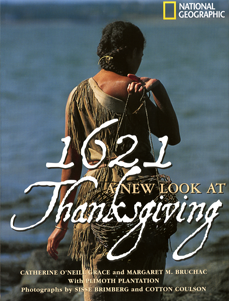
Today Americans worship those twin pastimes of indulging in food and football. How did this day, Thanksgiving, become a holiday? In searching for the best book on the topic, I discovered that there aren’t as many Thanksgiving books as you might think. Certainly the most intriguing on the subject is 1621: A New Look at Thanksgiving. It challenges a lot of our assumptions about this day by describing what happened when the fifty-two living English colonists celebrated their first successful harvest with Massasoit, the Wampanoag leader, who brought ninety of his men to the event.
The talents of author Catherine O’Neill Grace and Abenaki storyteller Marge Bruchac are combined in 1621, with the support of the National Geographic Society and Plimouth Plantation, the living history museum in Plymouth, Massachusetts. This knowledgeable group presents the best scholarship to date about Thanksgiving. As the authors suggest, the Wampanoag and Abenaki side of the story has been basically ignored for generations. They also provide a very different version of Pilgrims from the ones children may know. The real pilgrims wore bright clothing and engaged in “butchering deer, grinding corn, plucking birds, gathering shellfish, roasting meat” for a three-day celebration. I like the idea that festivities continued for three days—possibly that is where the concept of leftovers began! The book even includes recipes of the time in case you want to bring a bit of culinary history into your day. Outside of turkey and pumpkin, most of our traditional Thanksgiving dishes were never even tasted by the colonists.
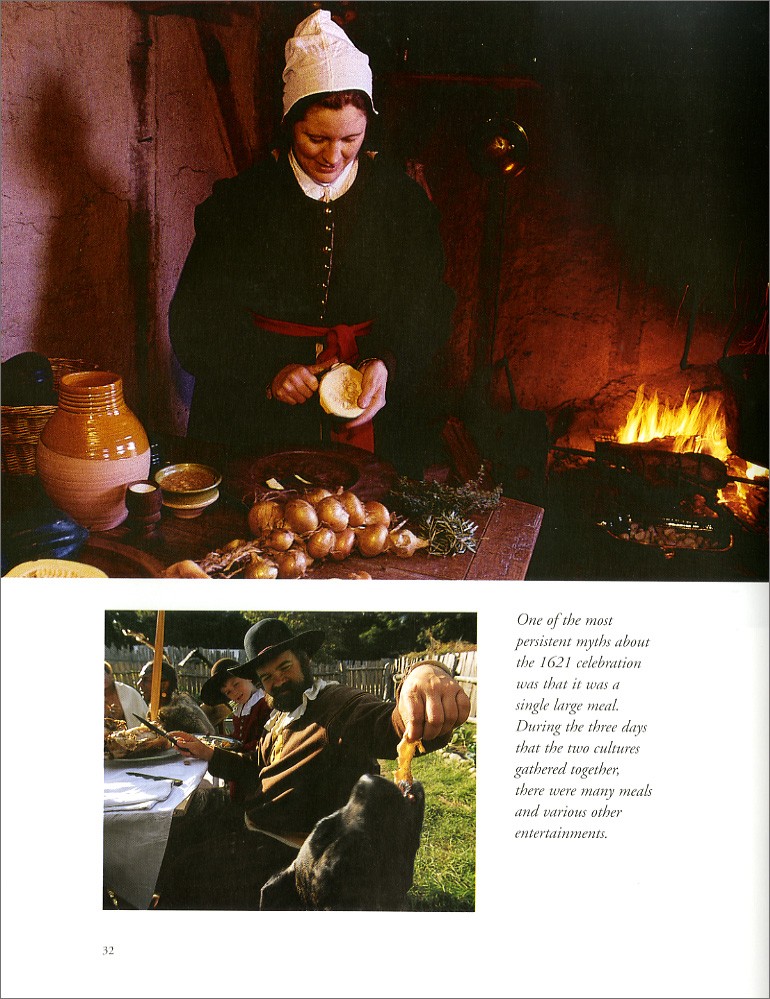
The book has been lavishly illustrated with photographs taken during Plimouth Plantation reenactments, and these give readers a sense of being present on this first Thanksgiving in 1621. The participants probably played games—although not football—and sang and danced. A very interesting section of the book explores the ongoing relationship of the settlers to the native people in New England. Since 1970 many Native Americans gather at the statue of Massasoit in Plymouth on Thanksgiving to remember the struggle of their ancestors.
Sometimes the present is best. Rather than enjoying a pilgrim Thanksgiving, I myself plan to tuck in to another slice of pumpkin pie. But I am glad that this multitalented group of authors provides such an interesting rendition of this day in 1621. Happy Thanksgiving.
Here’s a page from 1621: A New Look at Thanksgiving: